By GREGORY ZELLER //
From the species that thought up “I’m Only Happy When It Rains” comes statistical proof that haters gonna hate and bad news travels best.
 A new study by Stony Brook University behavioral scientists shows that social media posts with stronger negative emotions are “much more likely” to be shared by users.
This conclusion – reached via a unique analysis of actual and simulated social media posts – is evidence that a “negativity bias” holds sway across all media, including social media and mainstream news media.
And it’s proof-positive that negativity bias – a cognitive bias that results in adverse events having a more significant psychological effect than positive events – has played a central role in the rapid spread and stubborn persistence of easily debunked voter-fraud conspiracies surrounding the 2020 presidential election.

Mason Youngblood: Amplification investigation.
So says Mason Youngblood, a postdoctoral fellow in SBU’s Institute for Advanced Computational Science and lead author of five cranking out “Negativity Bias in the Spread of Voter Fraud Conspiracy Theory Tweets During the 2020 US Election,” published this month in the open-access science journal Humanities and Social Sciences Communications.
The telling thing, according to Youngblood, is not so much that voter-fraud theories were run up the flagpole, but that they’ve continued to proliferate.
“Conspiracy theories about large-scale voter fraud spread widely and rapidly on Twitter during the 2020 U.S. presidential election,” Youngblood noted. “But it is unclear what processes are responsible for their amplification.”
Hence the study, which consulted VoterFraud2020, a dataset of 7.6 million Twitter tweets and 25.6 million retweets – each including key phrases and hashtags like “election tampering” and “#stopthesteal” – between Oct. 23 and Dec. 16, 2020.
Youngblood et al leveraged that data into simulations of the behavior of roughly 350,000 Twitter users. The researchers ran tweeting/retweeting simulations at different cognitive-bias levels and compared the results to real tweeting/retweeting patterns among fraud-conspiracy proponents.
The results were clear: Negativity sells.
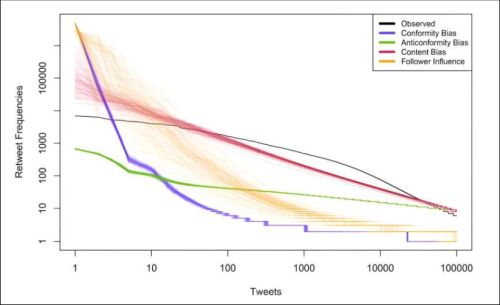
Mean tweets: On average, they do better.
“Our results suggest that the spread of voter-fraud messages on Twitter was driven by a bias for tweets with more negative emotion,” Youngblood said.
Further numerical analysis showed that negativity bias isn’t limited to platforms like the rebranded X or the quasi-cultish Truth Social, but is also directing mainstream news coverage and even political ideology.
All is not lost, according to Youngblood, who suggested the same technology that accurately simulated social media usage could potentially be used to simulate interventions against the future spread of misinformation – slowing the spread of posts through individual users’ timelines, for instance.
“This (research) has important implications for current debates on how to counter the spread of conspiracy theories and misinformation on social media,” the postdoc added.