By GREGORY ZELLER //
Stony Brook University biologists are going with the flow at unprecedented cellular levels – a deep bio-engineering dive that could alter understanding of life’s very building blocks.
 Tucked inside SBU’s Louis and Beatrice Laufer Center For Physical and Quantitative Biology, Henry Laufer Professor Gábor Balázsi – a physicist by training – has welcomed the FluidFM OMNIUM, a unique instrument designed by Swiss biotech Cytosurge AG to analyze individual human cells with previously impossible detail.
Balázsi’s cutting-edge workspace is one of only a handful of U.S. labs equipped with the FluidFM system, which allows researchers to manipulate single human cells – injecting and removing miniscule amounts of fluids, moving around the microscopic cells and more.
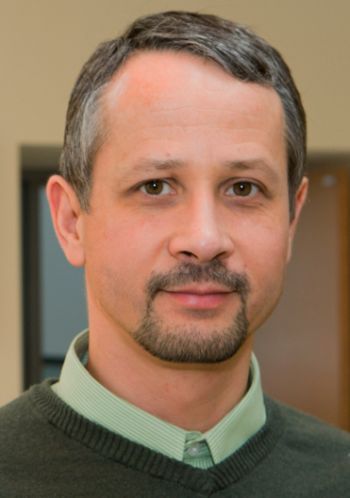
Gábor Balázsi: Cell mate.
That puts the Balázsi Laboratory “on the front line of single-cell research approaches,” according to the namesake scientist, who sees such research as essential to 21st Century medicine.
“Millions of cells in our tissues contain billions of molecules,” Balázsi said. “Central to the molecules is DNA, storing vital information in protein-coding genes.
“Yet, how these genes influence the behavior of individual cells – and thereby cell populations – is not completely understood.”
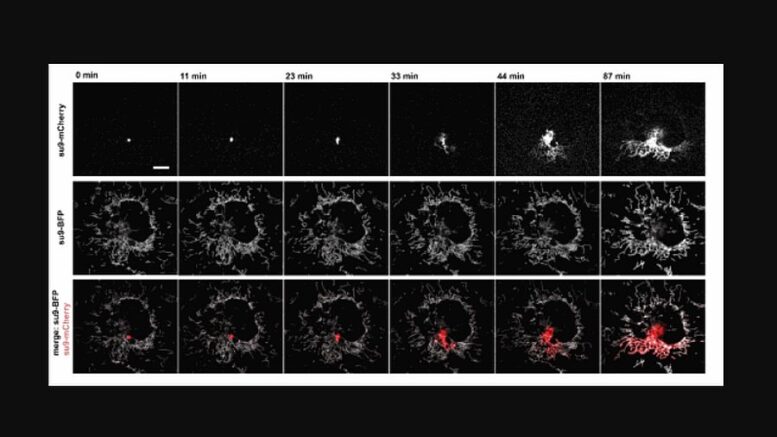
Enter the FluidFM, which combines cytoplasm targeting, nano-injections and other technological innovations to facilitate what SBU called “nondestructive single-cell manipulation” – including an “unparalleled capacity” for the repeated delivery and extraction of fluids to and from living intra-nuclear cells.
The Balázsi Laboratory is already putting the system through its paces, using the FluidFM to precisely modify individual-cell genomes and otherwise conduct living-single-cell studies. The Henry Laufer professor and his team are especially excited to begin examining, engineering and controlling multiple living cell lines as part of an exploration of potential cancer treatments.

Good to the last drop: The FluidFM can extract and inject fluids into living cells without destroying them.
“To learn how genes and gene networks control cell populations, we must understand first how gene-network dynamics affect single cells, and thereby cell populations,” Balázsi said. “Answering these questions will help us better understand the behavior and evolution of cell populations, which are the bases of cancer progression, microbial and cancer drug resistance and other cellular changes related to disease.”
Ultimately, what the SBU investigators learn about cells and cancer will embolden numerous researchers on several health-science fronts, the professor noted.
“If you understand cell populations based on what single cells do, that teaches us a lot about many diseases and how collective cell behaviors emerge in the disease process,” Balázsi added.