By GREGORY ZELLER //
There have not been many collegiate donations on this rarified level, and none – ever – for a public school.
 But public schools usually aren’t elite engines humming in the sweet spot of regional socioeconomics.
Stony Brook University is. And now the flagship State University of New York school has landed a gift for the ages: a $500 million donation from The Simons Foundation, the all-world philanthropic organization advancing the frontiers of science, mathematics and technology.
The monumental half-billion-dollar gift, announced Thursday by the foundation and the school, will actually keep on giving: It triggers an automatic $200 million public-funds injection from Albany, as per the donation-matching program included in this year’s New York State budget, and is likely to inspire other chunky endowments.
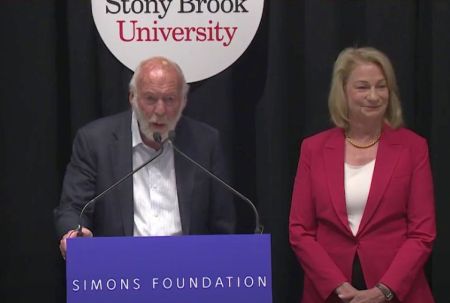
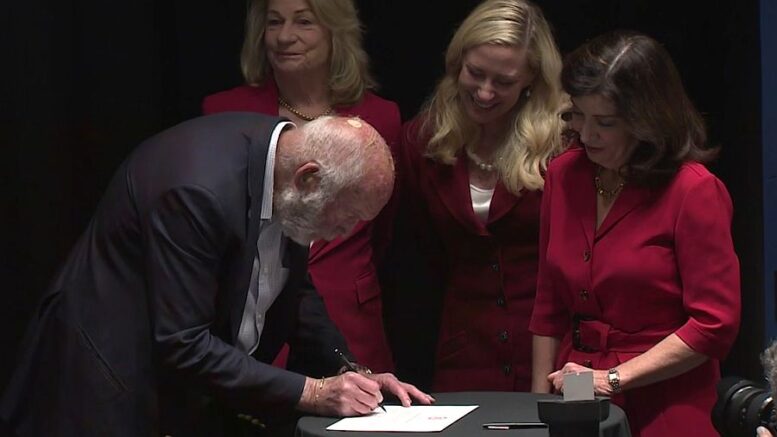
Gift cards: Jim and Marilyn Simons keep on giving.
It’s not quite a record-setter – Johns Hopkins University received a $1.8 billion donation in 2018 from alumnus and former New York City Mayor Michael Bloomberg and Stanford University snagged a $1.1 billion award in 2022 to create the Stanford Doerr School of Sustainability, with a half-dozen other U.S. collegiate donations weighing in at $500 million or more.
But the award from the circa-1994 Simons Foundation – formed by Stony Brook math professor-turned-billionaire hedge fund manager Jim Simons and his wife, Marilyn Simons, who earned her PhD in economics at the university – ranks among the largest ever bestowed upon an American university.
And, combined with the state’s matching funds, it more than doubles SBU’s current $370 million endowment – making Thursday a fairly ginormous day for a leading national institution with “no intention of slowing down,” according to Stony Brook University President Maurie McInnis.
“We take seriously our commitment to our students, our faculty and our broader community to advance knowledge and contribute to the most significant challenges facing our society,” McInnis said. “We are so proud of all that we have accomplished as an institution and our best days are ahead of us.

Michael Bloomberg: Fellow philanthropist.
“We are eternally grateful to Jim and Marilyn Simons and Simons Foundation President David Spergel for their unparalleled support of Stony Brook University.”
This was not The Simons Foundation’s first contribution to SBU, of course. Since the Simons made their initial $750 donation to the university in 1983, the foundation has committed more than $1.2 billion to Jim’s former employer and Marilyn’s alma mater, in support of the Renaissance School of Medicine, the Simons Center for Geometry and Physics, nine endowed chairs and a host of other progressive programs.
It was not even the foundation’s first nine-digit commitment to the university this year. In April, after SBU was named the anchor institution of the ambitious New York Climate Exchange, The Simons Foundation committed $100 million to the cause.
In a statement, Bloomberg – who made that record-setting 2018 donation to support undergraduate financial aid at Johns Hopkins, and has so far chipped in $50 million to the New York Climate Exchange through Bloomberg Philanthropies – applauded the Simons’ “long history of generously supporting the sciences, education and the health and wellbeing of New Yorkers.”
“This new gift is an extraordinary example of that,” the former NYC mayor added. “It will help Stony Brook University make critical investments that will empower more students to reach their full potential.”
 That’s the plan, according to the Simons, who noted personal reasons behind a historic donation that pushes their combined contributions to Stony Brook University well past the billion-dollar mark.
Marilyn Simons said she “know(s) firsthand the role that a quality education plays in the trajectory of one’s life,” adding that “Jim and I want to ensure that Stony Brook continues to serve its students with the highest level of educational excellence and with world-class resources.”
Jim Simons, who cofounded East Setauket-based Renaissance Technologies in 1982, said he recognized a “top intellectual center with a serious commitment to research and innovation” when he first joined the university’s faculty in 1968 as chairman of the Department of Mathematics.
“Stony Brook also gave me a chance to lead – and so it has been deeply rewarding to watch the university grow and flourish even more,” the former professor added. “Marilyn and I are proud to support this outstanding public university that has given us so much.”