By GREGORY ZELLER //
Part man. Part machine. All cop.
 That tagline for the 1987 technothriller “Robocop” is also an apt description for the Suffolk Crime Analysis Center, where human and digital intelligence team up to take it to the bad guys.
Located at the Suffolk County Police Department’s Yaphank headquarters, the center is a focal point for numerous agencies dedicated to counterterrorism and anti-crime initiatives. It features specially trained crime analysts, detailed criminal-justice databases and a state-of-the-art, 24-foot-high video wall, connected to an extensive network of video-surveillance devices, license-plate readers, squad-car trackers and helicopter-based video feeds.
And it’s been significantly supercharged.
Governor Kathy Hochul announced Friday a dramatic expansion of the SCAC, one of 11 networked Crime Analysis Centers located throughout the state. Albany has invested nearly $1 million to nearly triple the Suffolk center’s size – just 1,700 square feet when it opened in 2019, more than 5,000 square feet now – and double the number of law-enforcement professionals assigned there.
Their multifaceted mission: To respond to real-time requests for assistance from local police departments and provide the investigative support municipal agencies need to prevent and solve all manners of crime.
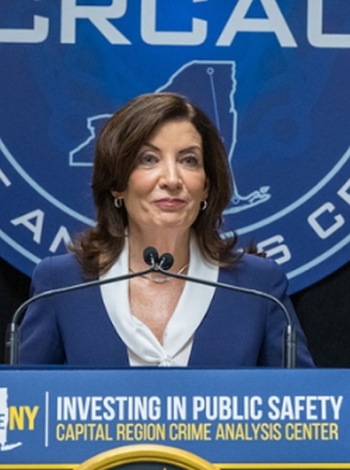
Gov. Kathy Hochul: Backing the blue.
So far, the center is doing its duty. According to preliminary data compiled by regional law-enforcement agencies and released by the governor’s office, 44 shooting incidents resulting in injury were reported in 2024 by the Suffolk County, Nassau County and Hempstead police departments – the fewest on record since 2006, when the three departments began reporting shooting data to the state.
Meanwhile, preliminary index-crime data covering January-September 2024 – the most updated data available, the governor’s office noted – shows a significant reduction in overall reported crimes on Long Island, compared to the first nine months of 2023. Violent crimes (murders, rapes, robberies and aggravated assaults) decreased 4 percent year-over-year, while property crimes (burglaries, larcenies and motor-vehicle thefts) decreased 7 percent.
That’s proof positive that the SCAC is having a positive effect, according to Hochul, who called public safety “my number-one priority.”
“This expansion enables law enforcement to share intelligence, analysis and support to identify hotspots and crime patterns that help them work smarter,” the governor added. “The intelligence-sharing and coordination facilitated by these centers allows law-enforcement agencies across the state to focus resources where they are needed most, maximizing our ability to keep New Yorkers safe.”
Funded primarily by the New York State Division of Criminal Justice Services and a host of state and local agencies – including interstate funding through the New York/New Jersey High Intensity Drug Trafficking Area program – the SCAC combines multiple inter-department resources, including intelligence gathered by various offices.
The Suffolk County PD, District Attorney’s Office, Sheriff’s Office, Department of Probation and Department of Family and Children’s Services all chip in; so do the Nassau County PD, the New York State Police, the New York Air National Guard and the NYS Department of Corrections and Community Supervision.
 New York’s Crime Analysis Center network is one of several statewide crime-reduction initiatives championed by the Hochul administration. The Suffolk County, Nassau County and Hempstead police departments, for example, are also among the 28 police departments and other statewide law-enforcement agencies – spanning 21 counties – that have shared nearly $36 million in funding through Albany’s Gun Involved Violence Elimination effort.
According to Hochul’s office, GIVE initiatives helped Long Island shooting incidents resulting in injury decrease by 39 percent (from 72 to 44) between 2023 and 2024, while the number of persons killed by gun violence on Long Island fell year-over-year from 16 to 10.
Albany’s SNUG Neighborhood Violence Prevention Program, which seeks to engage high-risk individuals known to cause violence in communities with high violent-crime rates, and Project RISE, which champions community-based gun-violence prevention by connecting with at-risk youth, are also “key initiatives … working to address the causes and consequences of gun violence and other crime,” according to the governor’s office.
But the Crime Analysis Centers are the cream of the anti-crime crop, insiders say, proving vital to both crime response and crime prevention.
New York State Division of Criminal Justice Services Commissioner Rossana Rosado trumpeted the CACs for their “more targeted, strategic approach to solving and deterring crime.”
“Crime analysts play a critical role in supporting law-enforcement investigations,” Rosado said in a statement. “I applaud the work of these dedicated public servants, commend our partners in Suffolk County and across the state for their continued collaboration and support, and thank Gov. Hochul for her investment in this vital work and commitment to keeping New Yorkers safe.”