By GREGORY ZELLER //
A Long Island-created solar technology – potentially, a long-term solution for noisy, diesel-powered construction-zone nightlights – is shining bright at Molloy College.
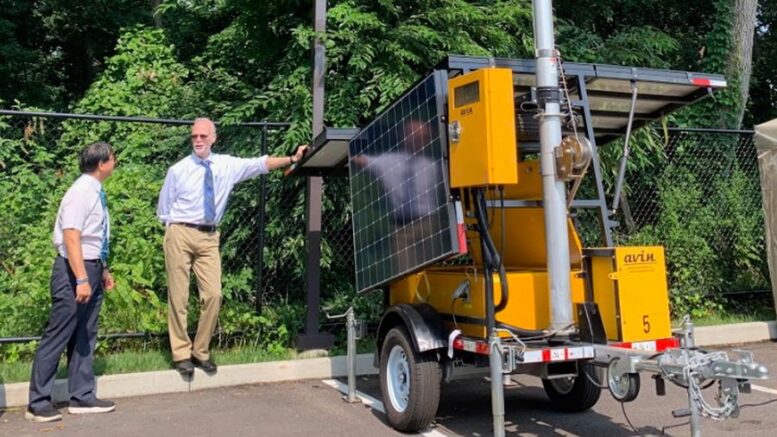
 The Apollo Lighting Tower is a 1,500-pound unit featuring a 20-foot mast and four 320-watt solar panels, powering LED lights that can illuminate a roughly 100-square-foot area. The panels charge an onboard battery system, creating a zero-emission and “nearly silent” lighting system, according to Amityville-based industrial equipment maker Biacomm.
The company is partnering with The Sustainability Institute at Molloy College in a test run that will see the Apollo tower – named for the Greek god of light, music, poetry, prophecy and medicine – beaming on Molloy’s Rockville Centre campus through the end of September. It’s the first Long Island deployment of the new Biacomm light tower, which is already being tested on the West Coast and in other areas.
Neal Lewis, executive director of The Sustainability Institute at Molloy College, said the institute was “thrilled” to partner with Biacomm on its first local test and “to advance environmentally responsible technologies like the Apollo.”

Neal Lewis: Solar impact.
“Throughout the summer, we will help BIACOMM generate data on the unit’s performance for future deployments, as well as use it to provide a nimble lighting solution on our campus where it might be needed,” Lewis said.
Biacomm, which butters its bread via equipment rentals, envisions the mobile technology – which sits atop its own wheeled trailer – as an ideal clean-gen solution for nighttime road work on highways and in parking lots. Lewis noted that a single traditional portable light tower, burning diesel for eight hours, “emits almost 90 pounds of [carbon dioxide], equivalent to a passenger car driving about 100 miles.”
“Multiply that by the thousands and thousands of units in use on nighttime construction projects across New York State, and you can see the impact these solar-powered units will have when they are fully deployed,” Lewis added.
Ultimately, the Apollo towers can do more than just light up nighttime construction zones, according to Biacomm founder and CEO Ming Chiang, who suggested multiple uses for the programmable, remote-start units.
“Our Apollo towers – for lighting, security, WiFi and more – can provide flexible and environmentally responsible options for highway departments, colleges, stadiums and arenas and outdoor festivals around the country,” Chiang said in a statement. “Our towers are designed to replace diesel-powered units that are loud and foul, as well as costly to maintain.”
 Even with its shakedown cruises underway, Biacomm is not done tinkering with the Apollo towers. The circa-2020 Amityville startup is preparing a study focused on repurposing retired electric-vehicle batteries and inserting them into the solar-powered lighting towers – potentially, a recycling cherry atop the Apollo’s low-carbon sundae.
Potential advances like that, and the Apollo towers’ basic solar technology, are right in The Sustainability Institute’s wheelhouse, according to Lewis.
“Our goal and purpose is to reduce environmental toxins, improve public health and promote smart planning that provides sustainable land use,” the executive director said. “Having a solar light tower on campus will help start the process of everyone using less diesel and incorporating more solar lights.”