By GREGORY ZELLER //
A national movement toward safe zones for pollinating insects – critical to the survival of wildflowers, agricultural crops and the myriad animal lifeforms they support – has reached Suffolk County.
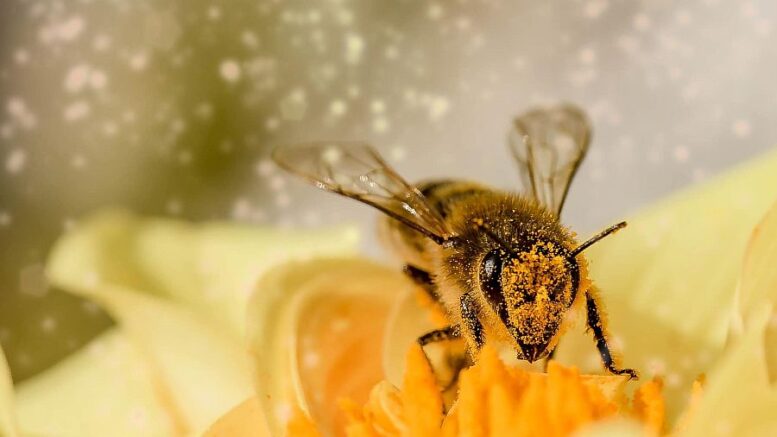
 Initiated by Cornell Cooperative Extension of Suffolk County, the Suffolk Alliance for Pollinators – yes, that’s SAP – will make county greeneries pollinator-friendly by introducing select food sources and otherwise constructing organic habitats for bees, butterflies, hummingbirds and other insects and wildlife flying critical pollination sorties.
Uniting a comprehensive alliance of civic groups, environmental organizations and garden clubs, SAP – which kicked off its crusade this month at CCE Suffolk’s Riverhead headquarters – lines up with the Pollinator Pathway, a national volunteer coalition spearheaded by artist and designer Sarah Bergmann.

Vanessa Lockel: Healthy backbone.
Pollinator Pathway’s mission: to establish a national network of pesticide-free native-plant corridors, providing nutritious habitats for pollinating insects and animals. Since its 2017 launch, the program has introduced more than 200 pathways throughout the Northeast and into Canada.
The effort comes with pollinator populations in freefall. Worldwide bee populations continue to decline rapidly, while global monarch butterfly populations have plummeted 90 percent over the last two decades – with loss of natural habitats in the United States and Mexico chiefly to blame.
The risk is not only to those endangered species, but to thousands of species across the heavily pollinated food chain – including the species currently at the top, with some estimates projecting one-third of all human consumables might be cropped by the pollination crisis.
That makes the work of the Pollinator Pathway – and local battalions like SAP – critically important, according to Cornell Cooperative Extension of Suffolk County Executive Director Vanessa Lockel.
“CCE Suffolk is proud to be leading this initiative,” Lockel said in a statement. “Pollinators are the backbone of a healthy environment, and we are excited to bring these groups together with the common goal of a pollinator-friendly Suffolk County.”
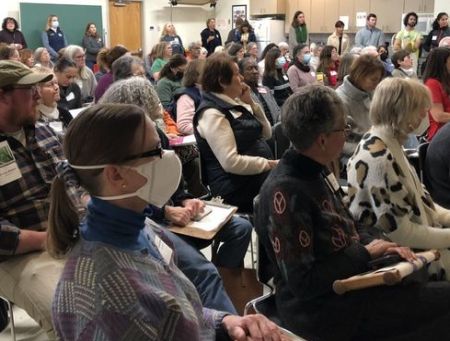
Bunch of SAPs: Environmentally conscious gardeners pack the SAP kickoff meeting in Riverhead.
In concert with public libraries and what CCE Suffolk called “a range of municipal entities,” SAP will educate home gardeners about innovative lawn-care techniques, cultivate native plants on public lands and otherwise promote pollinator-safe environments – most importantly, avoiding toxic pesticides at every turn.
Roxanne Zimmer, the CCE Suffolk community horticulture specialist who helped organize the SAP coalition, said the countywide effort basically formalizes gardening best practices already employed by SAP’s green-thumbed, environmentally conscious members.
“Many local groups are already engaged in protecting pollinators,” Zimmer noted. “Our new alliance will serve as a unifying platform that will help to share insights and amplify our voices.”