By GREGORY ZELLER //
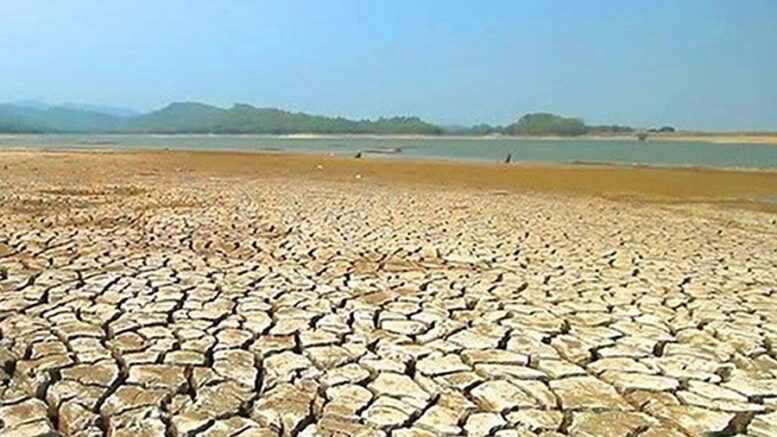
Worldwide droughts will cause mass human migrations over the next century, with entire populations on the move in Mexico, South America, Africa and elsewhere.
 That’s the dire warning contained in a new study out of Stony Brook University, which predicts a 200 percent increase in human migration due to drought through the remainder of the 21st Century – widespread human displacement that will require significant sociopolitical adjustments.
And at this stage of the climate-change cycle, that’s looking like the best-case scenario.
Published in April by International Migration Review, the New York City-based Center for Migration Studies’ peer-reviewed academic journal, “Climate Change, Drought, and Potential Environmental Migration Flows Under Different Policy Scenarios” is based on a series of top-ranked climate- and social-science modeling systems and other critical social-science data.

Oleg Smirnov: Immobile concerns.
Lead author Oleg Smirnov, an associate professor in SBU’s Department of Political Science, and multiple co-authors divide the study into two halves, each exploring a different greenhouse-gas scenario: an optimistic one consistent with the Paris Agreement, and a pessimistic one based on current levels of greenhouse-gas emissions.
Within those parameters, the study analyzes potential drought-induced human migration around the globe for the entire century ahead – and predicts increases over current migration levels as high as 500 percent, if world leaders fail to cooperate on climate-change mitigation.
And that doesn’t even count the massive potential increase in “immobile” peoples – populations that want to migrate but can’t, as droughts “[make] possible destinations difficult to get to, or inferior to their land of origin,” according to Smirnov.
Such populations will increase through the 21st Century by 200 percent – and that’s under the most optimistic scenario, with potential increases in “immobile” populations as high as 600 percent, according to the lead author.
“Our models make us not only concerned about the increasing number of environmentally displaced people that may spread across the globe,” Smirnov said. “We are equally, if not more, concerned about the large number of these ‘immobile’ persons.”
Gallya Lahav: The Refugee Convention doesn’t apply.
Those populations “may be desperate to leave but unable to do so,” the professor added, “which may contribute to social suffering and instability.”
Co-author Gallya Lahav, a migration specialist and Stony Brook associate political science professor, suggested international interventions are inevitable.
“Given that environmentally induced migrants largely fall outside of international legal frameworks like The Refugee Convention, which protects those fleeing war or conflict, a multilateral holistic policy approach is vital in this gray area,” noted Lahav, a former consultant to the United Nations Population Division.
While the researchers – five co-authors in all, also representing Princeton University and the University of Oregon – acknowledge “additional unknown variables and complexities” that could significantly skew their migration estimates, they insist there’s no doubt that large numbers of migrating peoples will soon be moving across Mexico, Venezuela, China, Egypt and other drought-stricken nations.
“Unmitigated climate change will likely produce major problems for human populations worldwide,” the scientists note in their abstract. “Despite the continued growth projections of drought-induced migration in all cases, international cooperation on climate change can substantially reduce the global potential for such migration.”