By GREGORY ZELLER //
The seeds of a year-round “food hub” have been planted in the Town of Riverhead, hailed by insiders as a key innovation against East End food insecurity.
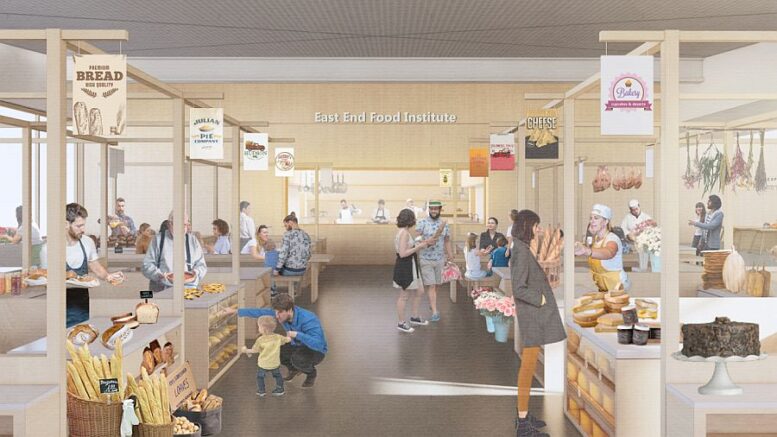
 The Southampton-based East End Food Institute announced plans for the East End Food Hub last week, envisioning a remake of the current East End Food Market. The market opened in November 2021, at the height of the COVID pandemic, and still operates sporadically throughout the year; now the EEFI is envisioning a new community kitchen – similar to the one it operates in Southampton – with expanded space for farmer’s markets, cooking demonstrations and social events.
Joined by EEFI board members Peter Treiber Sr. (of Southold’s Treiber Farms) and Mark-Antonio Smith (of East Hampton-based food-education platform The Nurtury for Kids), EEFI Executive Director Kate Fullam unveiled the plans Sept. 15 at East Hampton restaurant Nick and Toni’s, heralding a multifaceted strategy that will “help to diversify revenue streams for farmers while ensuring there is healthy, farm-fresh food for all people in need.”
“Access to fresh, local foods is important to our health and wellbeing,” Fullam added. “And it is a basic human right.”
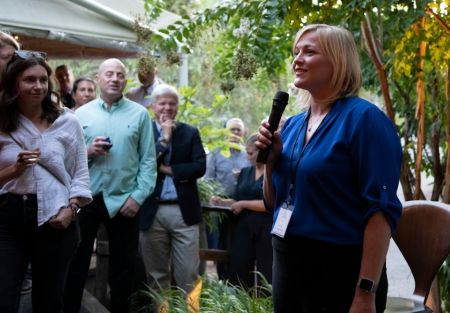
Today’s special: East End Food Institute Executive Director Kate Fullam spills the beans about the East End Food Hub.
The project – estimated by the EEFI to weigh in somewhere between $15 million and $20 million – faces a gauntlet of official town proceedings, and boldly shoots for the moon.
The plans laid out by Fullam and friends were broken into several phases, starting with a renovation of the existing 5,000-square-foot East End Food Market building, long the home of Homeside Florist, now leased by the EEFI from private property owners.
The projected $1.5 million Phase One renovation aims to create a “refined indoor farmers market and community kitchen that small-scale producers can rent to produce their goods,” according to the institute.
Phase Two would involve construction of a 7,500-square-foot multiuse building on the 4-acre Main Road property – warehousing, vendor spaces, event spaces, a farm-to-freezer processing facility and more – with a housing component included in future phases.

Mark-Antonio Smith: Community essentials.
The proposed East End Food Hub is a critical component of the EEFI’s mission to “spread awareness of the importance of supporting local farmers, food producers and an equitable local food system here on Long Island,” Fullam noted.
“It is essential for everyone to have access to what they see growing here in our community,” the executive director added. “You cannot drive around on the East End … without seeing a farm of some sort.”
And that farm-to-table-for-all mantra is only the start of the hub’s potential socioeconomic benefits, according to Nurtury For Kids founder Smith.
“This Food Hub project has the potential to contribute a great deal to the East End in critically significant ways,” the food educator said. “Dealing with food insecurity, educating residents and students about food issues and giving people the freedom and choices in what they are cooking and eating are all essential to our communities.”