
By GREGORY ZELLER //
German venture capitalists have locked and loaded a Stony Brook University spinoff’s next-generation weapon against malignant tumors.
 Munich-based VC firm TVM Capital Life Science – whose investment portfolios boast dozens of successful exits, including numerous IPOs on NASDAQ and the European exchanges – will commit up to $24 million to Recurv Pharma, a 2022 startup launched to flesh out an innovative “nano-emulsion formulation” that targets anticancer drugs specifically on solid tumors, while sparing surrounding healthy tissue.
Recurv has taken the ball from Stony Brook-based TargaGenix, a 2013 startup that’s spent a decade developing “guided molecular missiles” that deliver therapeutic payloads straight to target tumors.
The bench science is the work of SUNY Distinguished Professor Iwao Ojima, director of SBU’s Institute of Chemical Biology & Drug Discovery. Ojima has spent decades developing newer and better anticancer, antibacterial and anti-inflammatory agents, overseeing a laboratory on the cutting edges of cell biology, chemical biology and computational biology – three distinct and critically important sciences.
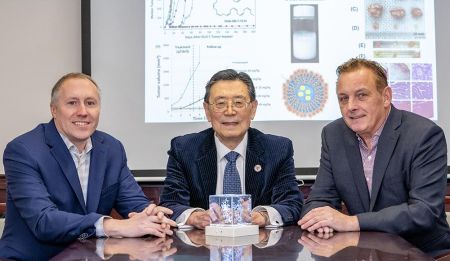
Throwing a Recurv: (From left) Intellectual Property Partners Director Sean Boykevisch, Distinguished Professor Iwao Ojima and Recurv CEO James Egan celebrate TVM Capital’s hefty investment.
The award-winning chemist – who earned undergraduate degrees and his PhD from the University of Tokyo and joined the SBU faculty as an associate chemistry professor in 1983 – is especially keen on overcoming a common flaw of conventional chemotherapy: the lack of tumor-specific treatments, which inadvertently damages otherwise healthy tissue.
One of the chemical agents emerging from his laboratory – a second-generation taxane conjugate in an all-new nano-emulsion formulation, since you asked, designed to block tumor growth by short-circuiting cancer cell mitosis – was licensed to TargaGenix in 2016.
The startup biotech has tinkered with formulations and toxicity levels and otherwise ushered the taxane, which has shown real promise against colorectal cancer and other solid tumors, toward clinical use.
And now Recurv has emerged to sublet the compound and carry it across the commercialization threshold – and it will, according to TargaGenix and Recurv CEO James Egan, who trumpeted a taxane that literally goes where no taxane has gone before: straight to its target.
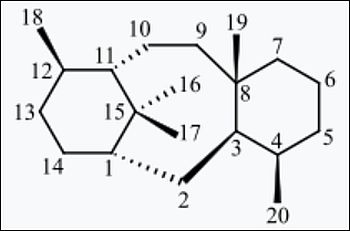
The taxane cometh: Everything you need to know about the unique taxane conjugate NE-DHA-SBT-1214.
“Taxanes have been a cornerstone of cancer treatment for decades, but they can come with significant side effects and treated cancers frequently recur,” Egan noted. “We are looking to provide a safer, more efficacious treatment option that may be used in combination with immunotherapies and in a far wider range of cancers, even those resistant to current taxanes.”
With the unprecedented molecule projecting as both a standalone therapy and a useful supplement to other treatments, the progressive effort has attracted the attention of TVM Capital, which will support Recurv through its $478 million TVM Life Science Innovation II fund.
The eight-digit infusion should carry Ojima’s original creation through the regulatory gauntlet, according to TVM Capital Life Science Managing Partner Luc Marengère, who sits on the Recurv Board of Directors and predicts a number of clinical applications based on the unique taxane.
“TVM is excited about the potential of this novel approach, which could introduce a new and safer taxane for cancers previously unresponsive to such treatment,” Marengère said in a statement. “TVM looks forward to working with James and the rest of the experienced team at Recurv to help them advance this important program into a clinical proof-of-concept.”
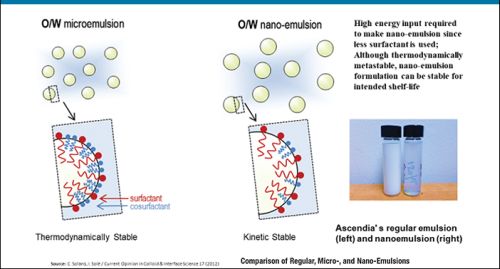
Emulsion-al outburst: Getting nano with it … possibly, the key to curing cancer.
Human trials are planned for “the near future,” according to SBU, which acknowledges significant challenges in prior taxane-based anticancer efforts – including the growth of cancer stem cells, often leading to recurrence, and a stubborn multidrug resistance to the taxanes themselves.
But powered by the evolving science of nano-emulsion formulation, Distinguished Professor Ojima’s unique anticancer agent – which incorporates a common omega-3 fish oil supplement, among other ingredients – has shown enough muscle to knock down multidrug-resistant solid-tumor stem cell models and go toe-to-toe with colorectal cancer, “a very challenging cancer to deal with due to strong multidrug resistance,” Ojima noted.
“But it also shows promise with pancreatic cancer and prostate cancer in preclinical testing,” the scientist added. “For example, we examined [the taxane] in combination with PLD-1 antibodies for pancreatic cancer (and) the combination therapy exhibited superior results over the current best-standard treatment against this deadly disease.”