
By GREGORY ZELLER //
Two giants of modern computing will help Stony Brook University improve its already-impressive digital game.
 The university is set to begin deployment of a new High-Performance Computing system, with components coming together this summer and the system – funded in part by the National Science Foundation and Empire State Development – expected to be operational in time for the Fall 2023 Semester.
It will be cobbled together with new technologies launched this year by California-based Intel Corp. and Texas-based Hewlett Packard Enterprise Co. – though “cobbled together” might slightly undersell a state-of-the-art supercomputer network designed to electrify research capacities across physics, medical technology, social sciences, engineering and other mission-critical 21st Century disciplines.

Robert Harrison: The revolution will be digitized.
Co-managed by SBU’s Institute for Advanced Computational Science and Division of Information Technology, the HPC system will combine Hewlett Packard’s ProLiant DL360 Gen11 servers – built specifically to play nicely with the latest in artificial intelligence, modeling, simulation and analytics programming – with Intel’s fourth-generation Xeon processors (including the Intel Xeon CPU Max Series, the only high-bandwidth x86-based processor, featuring 56 performance cores and an embedded multi-die interconnect bridge in a 350-watt envelope).
Okay, you glazed over there, but you’ll get this: When they flip the switch, SBU’s new HPC system will kick computational ass.
It will also mark Stony Brook’s biggest digital upgrade since the IACS installed the National Science Foundation’s Ookami supercomputer in 2020 – and a welcomed refresher for the university’s already-powerful SeaWulf Computational Cluster.
Robert Harrison, the IACS’s founding endowed director, said he was “excited by what this new generation of computer processors promises” and by SBU’s continuously expanding role in the global supercomputing realm.
“Some of the work may be up to eight times faster with this new HPC solution, compared to our current SeaWulf cluster,” Harrison said Monday. “Stony Brook’s leadership of the NSF Ookami project and our partnership with [Hewlett Packard] were instrumental in positioning us to successfully become the first university to use this revolutionary technology.”
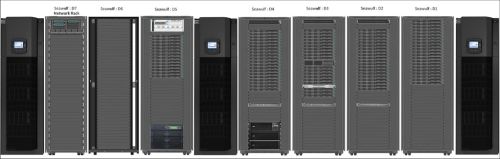
The rich get richer: The SeaWulf Computational Cluster is already nothing to sneeze at.
Also lending some tech – and a decidedly Long Island flavor – to the new HPC system is Huntington Station-based digital solutions provider ComnetCo, a frequent Hewlett Packard partner and longtime SBU computing collaborator.
Founded in 1995, ComnetCo has established a strong track record as a Hewlett Packard Enterprise primary partner, providing hardware, digital storage/archiving and system-management services to a long list of academic, government and corporate clients.
In addition to its unparalleled abilities supporting complex data and memory-intensive workloads, the coming-soon ProLiant DL360 Gen11 series also delivers significant environmental benefits.
 The Hewlett Packard servers boast a “closed-loop liquid cooling capability” that provides coolant solutions without additional plumbing infrastructure (by transferring heat into “coolant tubes”). They also require fewer overall racks, maximizing computer-center space.
Researchers across SBU’s diverse libraries and laboratories are already lining up. Materials Science and Chemical Engineering Department Chairman Dilip Gersappe raved about the forthcoming ability to simulate Arctic freezing and thawing cycles – “profound effects” on his advanced soil studies, Gersappe predicted – while Department of Physics & Astronomy Professor Alan Calder is practically drooling, in an astrophysical sense.
“It will greatly enhance multiscale, multi-physics applications like astrophysics,” Calder predicted. “Not only will models be able to include more physics and thus have unprecedented realism, but the system’s capacity will allow for performing suites of simulations for meaningful assessment of the uncertainty of the results.
“The new HPC system will be a boon for the whole campus.”