By GREGORY ZELLER //
You have to say this about NYSERDA: They think big.
 The New York State Energy Research & Development Authority has unveiled a three-year “Strategic Outlook” combining an ambitious environmental rescue mission and a bold economic-recovery plan – a low-carbon, high-employment blueprint addressing some of the biggest socioeconomic threats facing New York and the planet.
If that sounds like NYSERDA is on a quest to save the world, credit the melodrama to Acting President and CEO Doreen Harris, who in a letter to colleagues introducing the 2021-2024 Strategic Outlook invokes not only the COVID-19 pandemic but “powerful hurricanes, forest fires, floods and other extreme weather events,” framing them as calls to action for Albany’s top R&D unit.
New York, of course, doesn’t suffer many forest fires, and catastrophic flooding here is rare – though hurricanes are certainly seasonal threats, and coastal flooding is a constant concern.
And Harris’ overriding point is spot on: Whether it’s a global health crisis or an East Coast superstorm destroying 100,000 Long Island homes, the bad things tend to have “disproportionate impacts on certain members of our communities,” according to the CEO, bringing “the importance of NYSERDA’s work to the forefront.”
“There is no time to waste in our fight on climate change and realizing an equitable clean energy future for all New Yorkers,” Harris adds in her letter.
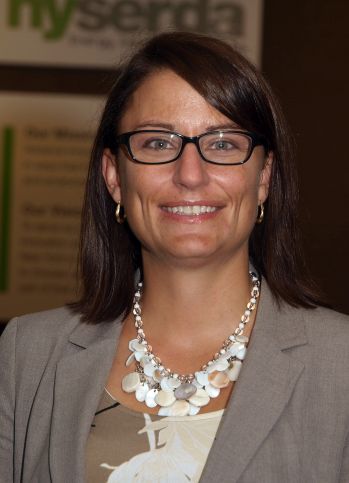
Dorren Harris: Three-year mission.
Enter the Strategic Outlook, a graphics-rich, statistics-heavy outline of NYSERDA’s key objectives through 2024, including greenhouse-gas reductions (85 percent below 1990 levels by 2050), mainstreamed renewable energy (providing 70 percent of all state electricity by 2030) and a rising clean-energy economy that not only cleans the air but employs tens of thousands of well-paid New Yorkers.
The 60-page report includes volumes of projections you’ve likely heard before (those greenhouse-gas and renewable-energy targets have all been reported ad nauseam) and a host of “climate progress” initiatives designed to meet them.
But certain passages are especially interesting to Long Island, where rainmakers are eager to establish a national beachhead for the offshore wind industry.
Among them: NYSERDA’s intentions to support the “build-out of OSW workforce training,” focused primarily on SUNY’s Offshore Wind Training Institute, which aims to train 2,500 workers through an “educational infrastructure” administered by NYSERDA, Farmingdale State College and Stony Brook University.
The Strategic Outlook also repeats Albany’s desire for 9,000 megawatts of offshore wind-generated electricity by 2035 – chum in the water for private developers – and includes programmatic and financial commitments intriguing to other Long Island workforce-development initiatives, including calls to support disadvantaged communities and “[transition] underemployed and unemployed workers into the clean-energy industry.”
And it speaks directly to SBU’s Clean Energy Business Incubator Program, Hofstra University’s Center for Entrepreneurship and other facilitators of the region’s startup community, promising to train “the next generation of entrepreneurial cleantech leaders” – including wide-ranging NYSERDA investments supporting new ideas for power grid optimization, clean transportation and more.
While the business-development initiatives, particularly the preparation of an OSW-ready workforce, bode well for Long Island, the comprehensive Strategic Outlook directly addresses climate and pandemic-recovery issues across all of New York State, according to Harris – and it doesn’t stop there.
“The convergence of crises in 2020 means the call to act on climate change and accelerate the energy transition has reached new levels of urgency and appreciation,” Harris said, noting last year’s multiple challenges “should leave us all with deeper appreciation for the interconnected nature of our systems, institutions and policy legacies that continue to perpetuate inequitable outcomes for disadvantaged communities and marginalized populations in New York State and beyond.
“New York will remain at the vanguard of climate progress,” she added.