By GREGORY ZELLER //
Two Long Island projects are among 28 statewide developments earning nearly $270 million in federal tax credits and other subsidies designed to spread new affordable-housing opportunities throughout New York.
 Governor Kathy Hochul and U.S. Rep. Paul Tonko (D-20th Dist.) met in Albany Tuesday to announce the nine-digit funding tranche, which leverages federal Low-Income Housing Tax Credits to help create or preserve more than 1,800 affordable, supportive and sustainable homes across the state’s 10 economic regions.
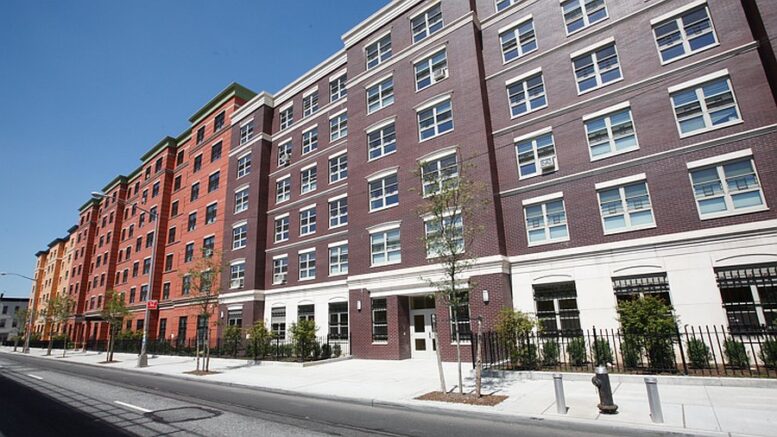
Long Island projects have attracted roughly $24 million through the funding round, including $15 million for One Carleton Green, a 96-unit mixed-income residential development in Central Islip featuring 15 supportive-services units and storefront commercial space.
Also in the roughly $270 million mix is $8.9 million for Port Jefferson Commons, a 53-unit, transit-oriented development that will combine workforce housing, supportive units and storefront commercial space in the Village of Port Jefferson. Located near the Long Island Rail Road’s Port Jefferson Station, this development has been identified as a priority project by the Long Island Regional Economic Development Council.
Created by the Tax Reform Act of 1986, the Low-Income Housing Tax Credit program is one of the most powerful and productive weapons in the federal affordable-housing arsenal. The program gives state and local LIHTC-allocating agencies – including the New York State Housing Finance Agency and the NYS Division of Homes and Community Renewal – the combined equivalent of approximately $10 billion in annual budget authority to issue tax credits for the acquisition, rehabilitation or new construction of lower-income rental housing.
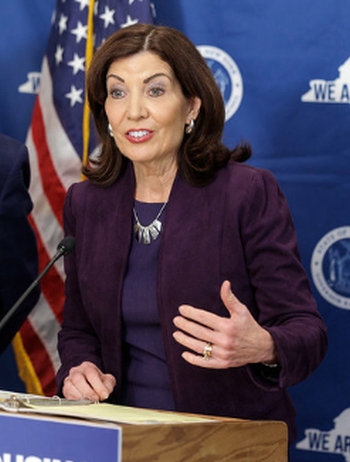
Kathy Hochul: Building toward something.
The funding round – which combines some $61 million in federal LIHTCs and more than $200 million in Division of Homes and Community Renewal subsidies – is an important piece of Hochul’s five-year, $25 billion housing plan, which was first announced in 2022 and ultimately aims to create or preserve 100,000 affordable homes around the state.
On Tuesday, the governor applauded the “critical federal resources” pushing her plan forward.
“Solving New York’s housing crisis comes down to one simple strategy: building more housing,” Hochul said. “[The housing tax credits] make it possible for us to provide New Yorkers with new opportunities to access affordable, modern, sustainable homes that also provide access to childcare, supportive services and the amenities that individuals and families need to thrive.”
Sustainability is a big part of the equation. All projects awarded through this funding round meet Homes and Community Renewal sustainability standards, which leverage goals set by the New York State Climate Leadership and Community Protection Act.
Many of the awarded projects are also being partially funded by the Clean Energy Initiative, an investment partnership between Homes and Community Renewal and the New York State Energy Research and Development Authority targeting even higher levels of carbon reduction.
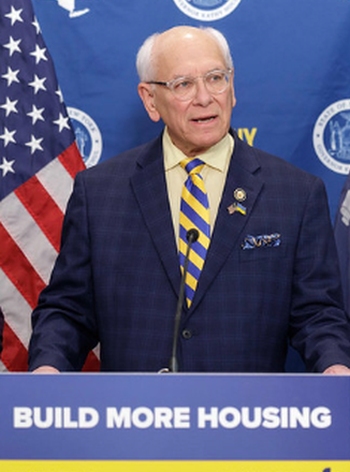
Paul Tonko: Everyone wins.
“Supporting affordable, sustainable housing benefits everyone in our communities,” Tonko said Tuesday.
Each of the 28 awarded developments – including four each in the New York City and Western New York economic zones; three each in the Central New York, Finger Lakes, Mid-Hudson, Mohawk Valley and Southern Tier regions; two in the North Country zone and one in the Capital Region – will also offer free broadband Internet services to residents.
That builds on Hochul’s ConnectALL initiative, which mandates the installation of high-speed Internet infrastructure in historically underserved communities – and is part-and-parcel of an equitable statewide housing system, according to Tonko.
“If we want to solve our historic home shortage, we must invest in affordable housing,” the congressman added. “At a time when millions struggle to afford quality housing, we must continue to drive smart investments like these that serve families across New York State.”