By GREGORY ZELLER //
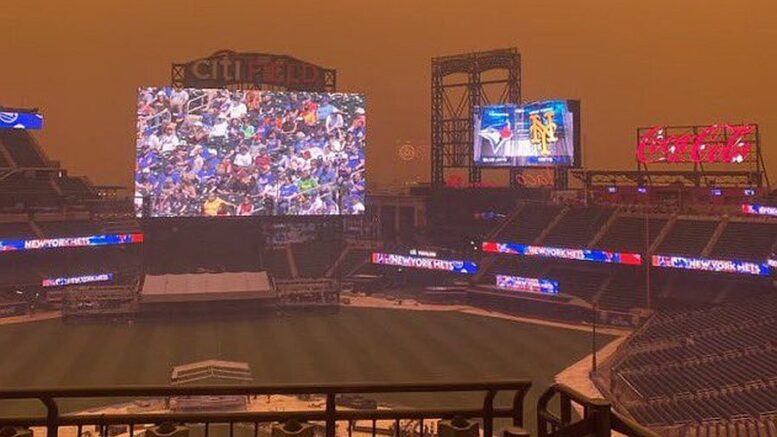
From the Department of Shared Experiences comes this week’s eerie and unhealthy Canadian wildfire smokestorm, engulfing Long Island and much of the Northeast region.
 More akin to a massive blizzard than a devastating terrorist attack or protracted pandemic, Wednesday’s persistent burning smell and billowing, post-apocalyptic haze – blotting the sun into a dull orange circle in an otherwise clear sky – certainly rank as a Where Were You When? moment: that time Greater New York looked like Downtown Mars.
More than 400 wildfires burned in eastern Canada on Wednesday, including 220-or-so deemed “out of control” by Canadian fire officials. While Thursday saw some thinner smoke swaths roll over the Northeast U.S., most of those wildfires were still raging – our neighbors to the north are on track for their historically worst wildfire season – and Long Island’s not out of the soup yet.
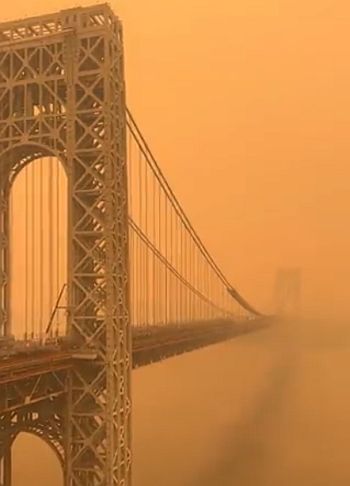
Smoke on the water: The George Washington Bridge in a fog.
In fact, with prevailing weather patterns affecting this region – a strangely unseasonal northeasterly flow, more akin to winter – not forecasted to change until this weekend, New York City, Nassau and Suffolk could be in the smoker through Friday at least.
At one point Tuesday night, the Smoked Apple registered the worst air quality of any major city in the world, worse even than the air in New Delhi (India), Baghdad (Iraq) and other notorious pollution corridors. All told, air-quality alerts – including red flags in Nassau and Suffolk – have affected more than 110 million Americans, as far west as the Ohio Valley and as far south as South Carolina.
Depending on the length of exposure and the severity of a particular pocket, air pollution from wildfires can make breathing difficult for anyone – but especially older adults, younger children, pregnant women and people with serious respiratory conditions like asthma or chronic obstructive pulmonary disease.
Minute particulates in the dirty air can irritate the eyes, throat and nasal passages, and that’s the least of it: The threat of a respiratory infection or other lung damage is real.
With the poor air presenting a serious risk to some populations and a moderate risk to even the healthiest adults, Long Island officials sprang to action on Wednesday, canceling school field trips, initiating safety protocols for unionized laborers and otherwise limiting exposure to hazardous outdoor conditions.

James McDonald: Duke of hazards.
Triggering flashbacks of the COVID pandemic, Gov. Kathy Hochul’s office on Thursday announced that 1 million N95 facemasks would be made immediately available to New Yorkers, including 400,000 for public distribution across New York City at Metropolitan Transportation Authority and New York State Parks facilities, among other sites.
Another 600,000 will be dispersed throughout the state by local governments, according to the governor’s office.
Acting New York State Health Commissioner James McDonald said state officials were “particularly concerned about the New Yorkers who are most vulnerable to negative health impacts from unhealthy air quality,” including the elderly, the very young and expectant mothers.
“The best way for vulnerable individuals to protect themselves is to stay inside, reduce exposure and minimize exertion when outdoors,” McDonald said in a statement. “If you must go outdoors, please use a high-quality, well-fitting mask while these unhealthy conditions persist.
“And, for the areas where the air quality is designated as ‘hazardous,’ than that recommendation applies to everyone.”