By GREGORY ZELLER //
There’s a lot going on this summer in coastal waters, and shark attacks are the least of it.
 The winds of change blow consistently through the National Offshore Wind Research and Development Consortium, a (literally) coast-to-coast resource for wind-power scientists and executives. Funneling federal funding to wind-power technology development and deployment keeps the consortium on the ever-shifting forefront of the burgeoning, and critically important, domestic industry.
But this summer, change is really gonna come at the NOWRDC, and it’s all good.
Right at the top, the consortium – a collaboration of the U.S. Department of Energy, private researchers and energy administrations from six East Coast states – is preparing to announce its latest round of competitive grant awards.
The successful solicitations, pushing the three-year-old association to 52 grants totaling roughly $35 million, will be announced in the coming weeks, according to Acting Executive Director Kevin Knobloch, who applauded another successful notch on the NOWRDC’s belt.

Kevin Knobloch: Questions answered.
“The core mission … is to run solicitations that put grant funding out into the world to advance offshore-wind technology innovation,” Knobloch told Innovate Long Island. “It’s been really successful in that pursuit.”
For its next success, the consortium is diving deep into what the acting exec called an “offshore wind research-and-development roadmap.”
With some beta-level research already in hand, the NOWRDC will spend the summer surveying offshore developers, original equipment manufacturers, research universities, national laboratories, local government agencies and others with skin in the offshore-wind game, with a national industry forecast/master plan expected sometime in 2023.
“We’ll get a real sense of the priority technology problems that need to be funded and explored,” Knobloch noted. “Technology innovations that might reduce the cost and risk of offshore wind, might reduce harmful impacts on marine species, might enhance systems management.
“These are big, complex operations out in the ocean,” he added. “They need to be interconnected, and connected to the grid, and so on.”
And speaking of complex operations requiring a particular kind of connectivity, the consortium is knee-deep this summer in its search for a new permanent executive director. Knobloch – who served four years as U.S. Energy Department chief of staff and became acting NOWRDC exec in May after the resignation of the consortium’s first executive director, industry veteran Carrie Cullen Hitt – said the NOWRDC would accept job applications through July 29, with some “good competition” expected.
One name that won’t be in the hat is his own: Knobloch is not in the running for permanent executive director, intent on returning his primary focus to Knobloch Energy, his Massachusetts-based industry consultancy.
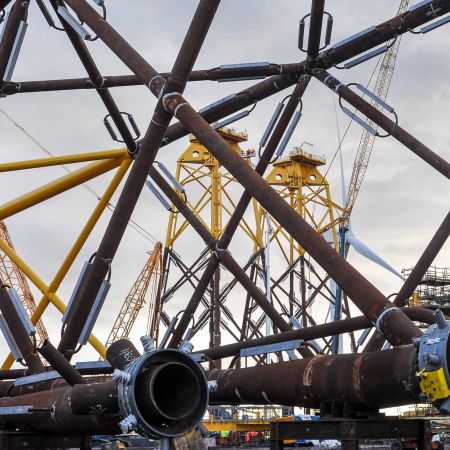
Not as simple as it looks: Offshore-wind power generation and distribution is a massively complex undertaking, Knobloch notes.
“We’re looking for someone who is a strong, capable leader and manager,” said Knobloch, who also served 10 years as president of the Union of Concerned Scientists. “Someone who is really passionate about advancing the development of offshore wind in the United States.”
While the position is U.S.-based, the NOWRDC is “certainly open to international applicants,” according to the acting exec, who noted offshore wind’s “huge international flavor.”
“The Europeans have been developing offshore wind for years,” Knobloch added.
While the stakes are huge and the search will be comprehensive, the consortium won’t be hiring a big search firm, according to Knobloch, choosing instead to conduct its recruitment effort “organically.”
“We’re a small nonprofit,” he noted. “So, we’re asking our board members and partners to spread the word.”
That’s a fairly brilliant start to any energy-industry recruitment effort: Those board members and partners represent progressive government agencies, cutting-edge utilities and other private-industry leaders from up and down the Eastern Seaboard, running with exactly the kind of ambitious sort Knobloch et al envision as the new NOWRDC exec.
Whoever lands the permanent gig will have big shoes to fill. Under Hitt and since her sudden departure, the NOWRDC has grown into a “wonderful organization,” according to Knobloch, who did place one restriction on job applicants: Anyone who doesn’t dig next-generation sciences need not apply.
“It will be someone who loves science and technology, someone who loves exploring and developing solutions to scientific and technological problems,” Knobloch said. “It’s a very exciting opportunity for somebody who has led organizations before and is ready to step up.”