By GREGORY ZELLER //
Unique cancer treatments, customized to specific patients, may be on the way.
 Among the things making cancer so vexing are the many physiological variables in play, suggesting no one-size-fits-all solution will ever provide sufficient protection or treatment.
Enter the Feinstein Institutes for Medical Research, Northwell Health’s Manhasset-based R&D mothership, where personalized cancer cures are moving rapidly from abstract rhetorical question to powerful treatment plan.
 During a presentation at the American Surgical Association’s 142nd Annual Meeting, held earlier this month in Chicago, Matthew Weiss – a professor at Feinstein’s Institute of Cancer Research and deputy physician-in-chief of the Northwell Health Cancer Institute – shared the results of a recent study of how pancreatic cancer patient-derived organoids responded to certain chemotherapy treatments.
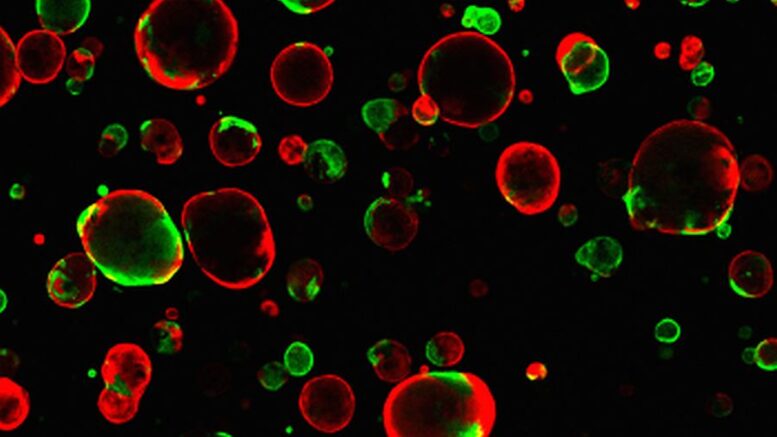
Organoids are artificially grown cell or tissue masses that resemble human organs. The Feinstein Institutes study collected 136 tumor samples from 117 pancreatic-cancer patients and grew organoids from them in a “3D gel matrix” in a petri dish; scientists then studied their sensitivity to various chemotherapy treatments.
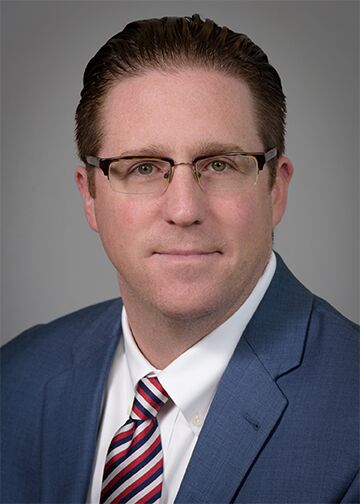
Matthew Weiss: Precision vision.
Performed in collaboration with Cold Spring Harbor Laboratory Cancer Center Director David Tuveson and other CSHL scientists, the study proved that researchers could generate organoids from pancreatic-cancer patients regardless of tumor stage or progression – even from patients who’d already undergone chemotherapy.
Further, it suggested that laboratory testing of those organoids can help predict the effectiveness of different chemical treatments on the specific patient from which they’re grown – key to creating patient-specific therapy plans.
Pending editorial review, the research is slated to be published soon in the peer-reviewed scientific journal Annals of Surgery. But presenting the findings to the ASA already marks “an important step in advancing this research, adding a powerful new tool in our fight against pancreatic cancer,” according to Weiss, who is also a professor of surgery and oncology at the Donald and Barbara Zucker School of Medicine at Hofstra/Northwell.
“We are seeing real-time, precision cancer care thanks to significant scientific advancements,” Weiss added.