By GREGORY ZELLER //
Stony Brook University will head up a heavy-hitting roster of major players looking to supercharge the nation’s quantum-computing abilities.
 The State University of New York flagship institution has been selected to lead a new U.S. National Science Foundation effort to advance quantum information science and technology across the United States – specifically, to construct a long-distance, 10-node quantum network that demonstrates “quantum advantage” by facilitating quantum communications and distributed quantum computing.
The project – one of five funded by the NSF’s groundbreaking National Quantum Virtual Laboratory program, each receiving $1 million – will team Stony Brook’s Center for Distributed Quantum Processing with experts from Columbia University in New York City, Yale University in Connecticut and Upton-based Brookhaven National Laboratory, a frequent SBU research partner.
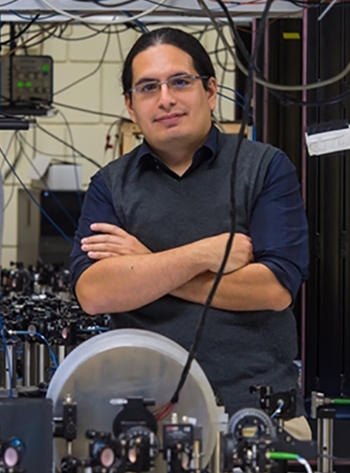
Eden Figueroa: Quantum leaper.
The “Wide-Area Quantum Network” they will construct would, ostensibly, enable secure and privacy-preserving long-distance communications systems on the quantum level – potentially, a landmark quantum-computing achievement representing nothing less than “a first version of the Quantum Internet,” according to Principal Investigator and CDQP Director Eden Figueroa, a Presidential Innovation Endowed Professor in SBU’s Department of Physics and Astronomy.
“This project has the potential to boost the scaling of quantum computing systems via quantum networks,” noted Figueroa, who holds a joint appointment as a staff member in BNL’s Instrumentation Department. “To realize this ambitious vision, we have assembled a team of the leading quantum physicists, electrical engineers and computer scientists in the region.”
Along with superstars from SBU’s Department of Computer Science and Department of Physics and Astronomy, the team includes big thinkers from Columbia’s Department of Applied Physics and Department of Electrical Engineering, as well as representatives of BNL’s Instrumentation Department.
The team collaborated on “NQVL:QSTD: Pilot: Wide-Area Quantum Network To Demonstrate Quantum Advantage,” the proposal that earned one of the five NSF funding deals.
Known colloquially as “SCY-QNet,” the pilot “aims to demonstrate quantum advantage in meaningful applications,” according to Figueroa, “enhancing current information systems, such as long-distance hack-proof encryption and data communication via teleportation.”
 “It can also be an instrument to gain insights into unknown physical phenomena that require entangled systems to be understood,” the professor added.
Co-primary investigator Himanshu Gupta, a professor in SBU’s Department of Computer Science, noted a “compelling need” to develop new quantum-network infrastructure, which can “serve as the foundation to develop applications demonstrating quantum advantage.”
“We envision SCY-QNet to fulfill that need by developing a user-configurable shared quantum-network infrastructure – a ‘virtual laboratory’ – allowing researchers and engineers to develop and experimentally validate new ideas,” Gupta added.
Researchers also referenced an ancillary goal of this far-reaching effort: the cultivation of a quantum-ready workforce.
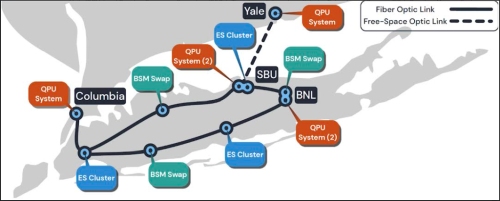
Ten-point plan: The “Wide-Area Quantum Network” will be a portal to the future Quantum Internet.
“For the New York metro area and beyond, SCY-QNet positions our region as a leader in quantum information science and technology,” Hong Tang, a Yale professor of electrical and computer engineering, applied physics and physics, said in a statement.
Other programs funded in the first round of the NSF’s National Quantum Virtual Laboratory include the creation of a 256-qubit “ion-trap quantum computing system” and the formation of a “quantum-sensing imaging lab.”
But none are more important – or aspiring – than the Stony Brook-led pilot, which leverages “the importance of collaborative scientific discovery for societal advancement,” according to SBU Senior Associate Vice President for Research Development and Partnerships Nina Maung.
“We are thrilled to have received this inaugural award from the National Science Foundation alongside our partner universities,” Muang said. “It represents the considerable efforts each institution has dedicated to re-envisioning the future of quantum information science research.”