
By GREGORY ZELLER //
A review of nearly two decades of publications in the nation’s top medical journals shows a clear bias against women authors.
 Led by researchers from Stony Brook University’s Renaissance School of Medicine, a new scientific study has calculated authored papers in The New England Journal of Medicine, the Journal of the American Medical Association and The Lancet – a weekly, peer-reviewed general medical journal ranked among the world’s best – between 2002 and 2019.
The 18-year analysis, which randomly sampled 1,080 author citations in published papers, tested for first-, second- and last-significant author disparities – and discovered what the researchers termed a “gender disparity chasm,” with women listed as first author on just 26.8 percent of sampled papers.
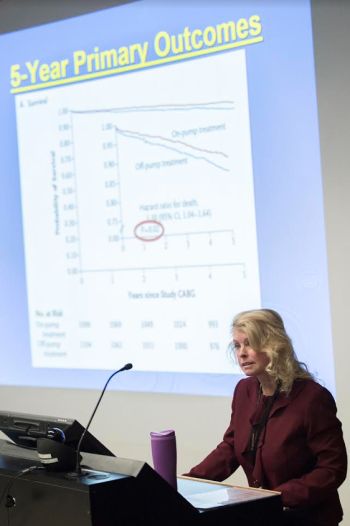
Author, author: The numbers don’t lie, according to Renaissance School Research Chairwoman A. Laurie Shroyer.
Besides barely accounting for a quarter of all papers published by the distinguished journals, that’s well below the rate of U.S. full-time women medical faculty (37.2 percent, according to SBU).
Women authors were “similarly underrepresented” in the second- and last-author slots, according to the findings, which were published this week in PLOS ONE, the Public Library of Science’s open-access, peer-reviewed journal.
Women first authors also registered lower Web of Science counts – measuring author impact on a publisher-independent, global citation database popular among researchers – and much less likely than men to publish work on clinical trials or cardiovascular-related research, according to the novel study.
More than just a disturbing trend, the research clearly demonstrates “another aspect to the glass ceiling in medicine,” according to co-senior author A. Laurie Shroyer, vice chairwoman of research and a surgical professor at the Renaissance School, who shares top billing here with co-senior author Henry Tannous, co-director of the Stony Brook University Heart Institute.
“Considering the advances women have made contributing to science and medicine in recent decades, these results show a clear indication of a gap between men and women authorship,” Shroyer added.

Henry Tannous: Alignment proponent.
And that gap has a self-perpetuating domino effect: The researchers identified a problem – and an opportunity – with what they dubbed “gender alignment,” wherein a publication’s first and last authors are the same sex.
While the relationship between first and last authors is not automatically understood to be a mentor-protégé relationship, it often is exactly that – and regardless, Shroyer and Tannous note, it’s an inherent opportunity to foster mentor-protégé-type bonds.
With their research showing higher publication rates among publications where first and last authors are the same gender, gender alignment – more specifically, gender-based “author alignment” – may be “a strategy to mitigate gender inequalities,” according to the researchers.
“First/last author woman-to woman collaborations appear to hold promise to mitigate the tremendous women authorship gender disparities that are documented,” Shroyer said. “Our ongoing research projects are evaluating this novel concept of author ‘gender alignment’ more closely.”