By GREGORY ZELLER //
It’s a fundamental step! No, it’s a quantum leap!
 You’re both right!
However you describe it, Stony Brook University scientists have cleared a big hurdle on the road to a functioning “quantum Internet” – a network of quantum computers, sensors and communication devices that will provide ultra-advanced services and securities well beyond the current Internet’s capabilities by creating, processing and transmitting quantum states and entanglements.
In a paper published in January in Nature’s peer-reviewed, open-access scientific journal Quantum Information, an SBU research team demonstrated a network of quantum memories displaying “identical performance at room temperature” – what the university describes as “a fundamental step toward developing quantum repeaters” and a prerequisite of true quantum communications.
The team – which has also secured two U.S. patents, one for room-temperature quantum storage (traditionally requiring near-absolute-zero temperatures) and one for high-repetition-rate quantum repeaters – further demonstrated that storing and retrieving optical qubits in their room-temp quantum-memory device doesn’t significantly distort the “joint interference process.”
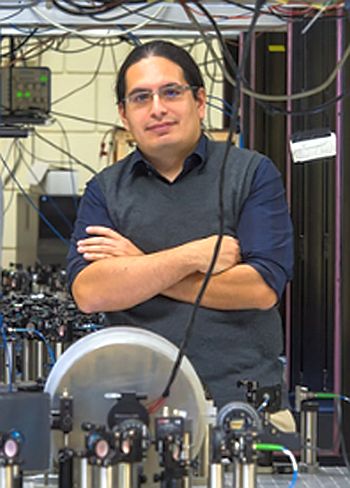
Eden Figueroa: Unprecedented quantum progress.
That, obviously, facilitates memory-assisted entanglement swapping, the key to building operational quantum repeaters.
Yes, the science is thicker than molasses at … well, absolute zero. But put simply, constructing and characterizing quantum memories that function at room temperatures – and demonstrating identical performances, essential to large-scale quantum-repeater networks – are key to creating communication networks that are more secure, more precise and way more powerful than anything in use today.
“We believe this is an extraordinary step toward the development of viable quantum repeaters and the quantum Internet,” noted Stony Brook Presidential Innovation Endowed Professor Eden Figueroa, the lead author of 10 listed on the breakthrough study and director of the Center for Distributed Quantum Processing, a joint effort of SBU and the U.S. Department of Energy’s Brookhaven National Laboratory.
“To get these fleets of quantum memories to work together at a quantum level, and in a room-temperature state, is something that is essential for any quantum Internet on any scale,” Figueroa added. “To our knowledge, this feat has not been demonstrated before.”
Developing quantum hardware that functions at room temperatures has the potential to mainstream the next-level science by significantly lowering the costs of creating such networks (maintaining a work environment around -459.67 degrees Fahrenheit, where a system reaches its lowest possible thermal motion, isn’t convenient and ain’t cheap).
The science of quantum repeaters, meanwhile, is similarly head-spinning. Essentially, it involves two sources of entangled photon pairs that are separated, with one photon from each pair stored in quantum memories in a central location and their partner photons sent somewhere else; according to SBU, a measurement “quantifying the indistinguishability” of the photons in the central location is used to entangle the separated photons.
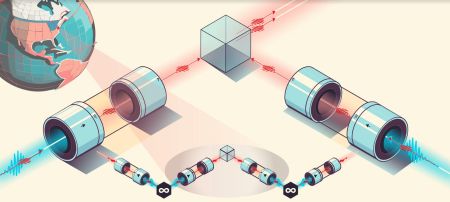
Repeat performance: Your basic quantum repeater, in action.
Again, it’s heady stuff – but it’s where science needs to go to create quantum Internets.
To get there, Figueroa and co-authors Sonali Gera and Chase Wallace (a postdoctoral researcher and doctoral student, respectively, in SBU’s Department of Physics and Astronomy) have worked closely with colleagues at Italy’s University of Padova and Brooklyn quantum-tech firm Qunnect, a 2017 startup launched by Figueroa and friends and now in the capable guiding hands of CEO Noel Goddard, a veteran research scientist, investor and entrepreneur.
While significant progress has been made, there’s still a long way to go – and the international collaboration of big brains is just getting started, according to Figueroa.
“We expect to build on this research,” the professor said.