By GREGORY ZELLER //
New findings by St. Joseph’s University-New York researchers may lead to new and better techniques for monitoring microplastics pollution in global waterways.
 A study published in May in Marine Environmental Research, a peer-reviewed scientific journal focused on chemical, physical and biological interactions in oceans and coastal waters, offers a large-scale analysis of the ways in which invertebrates eat – and suggests that these feeding patterns could be used to track levels of microplastics contamination in different regions.
Microplastics contamination occurs when tiny plastic particles, often smaller than 5 millimeters, are released into the environment via the breaking down of larger plastic materials (such as bottles and bags); manufacturing, construction and other industrial processes; the use of plastic mulch and other agricultural side effects; the improper disposal of cosmetics and numerous household products; and various other direct or indirect means.

Konstantine Rountos: Plastics man.
St. Joseph’s University Associate Professor of Biology Konstantine Rountos and graduate student Afifah Khan dive deep into these pollutants and their deleterious effects on marine environments in “Evaluation of Microplastics in Marine Selective and Non-Selective Suspension-Feeding Benthic Invertebrates,” a macro-analysis of 144 previous peer-reviewed articles.
Those prior publications include data on 131 different invertebrate marine species – a goldmine of information detailing how those backboneless creatures feed and their consumption rate of microplastics, a proliferating threat to oceanic ecosystems.
Rountos and Khan, who graduated from St. Joe’s in 2024 with a degree in biology, are the first scientists to systematically compare microplastics contamination on a global scale between selective “deposit-feeding” invertebrates (including oysters, mussels and clams, which consume organic materials that settle on or near the seafloor) and nonselective suspension-feeding invertebrates. “Suspension-feeding,” also known as “filter feeding,” refers to the capture and ingestion of food particles suspended in the water – common among fish and free-floating invertebrates (including sponges and tunicates).
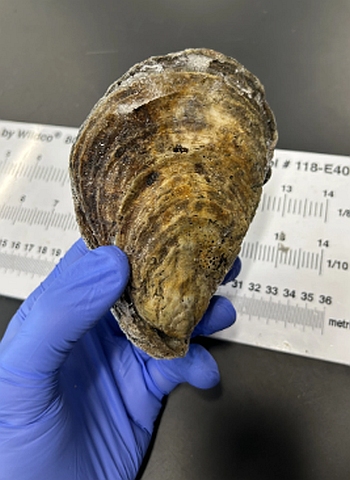
You are what you eat: “Deposit-feeding” oysters ingest plenty of microplastics — but not as many as “suspension-feeding” invertebrates.
According to the St. Joseph’s researchers, both selective and nonselective feeders showed levels of ingested microfibers and microplastic fragments – polyethylene, polyethylene terephthalate and polypropylene were the most common polymer types – but nonselective feeders consumed significantly higher microplastics concentrations.
The study – Rountos’ third peer-reviewed published study in five years – also found significant differences in microplastics presence across different taxonomic groups, referencing a ranking system that organizes organisms on levels ranging from broad to specific (in order: domain, kingdom, phylum, class, order, family, genus and species).
While the science runs deep, the surface-level revelations are clear, according to the study’s senior author – and suggest the potential development of hyper-targeted contamination-monitoring strategies in marine environments.
“These findings underscore how feeding behavior directly influences microplastic concentrations,” Rountos noted. “Non-selective feeders … may serve as critical sentinel species for monitoring marine microplastic pollution.
“The Department of Biology at [St. Joseph’s University] prides itself on offering our undergraduates world-class research opportunities,” the associate professor added. “They can be biologists – and not just learn from a textbook.”