By GREGORY ZELLER //
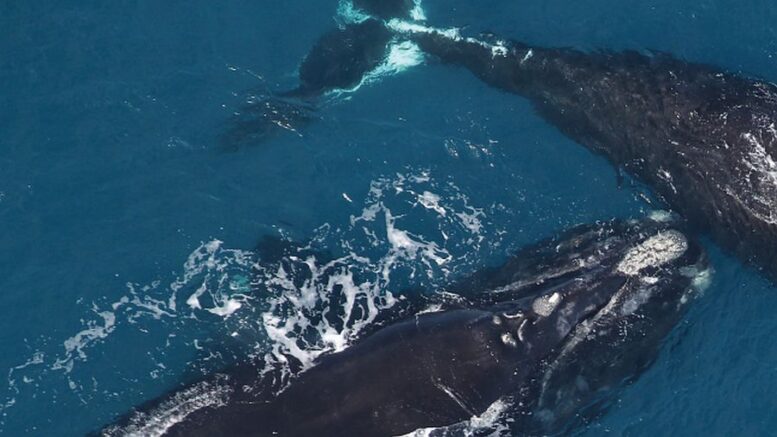
Citing risks to endangered North Atlantic right whales, an international ocean-advocacy group wants vessels to throttle back in established “slow zones” – including the almost 90 percent of boats speeding through westernmost Long Island waters.
 Oceana, a Washington-based watchdog knee-deep in oceanic conservation, released a new report Thursday revealing unchecked speeding by boaters traveling National Oceanic and Atmospheric Administration speed-monitoring zones up and down the East Coast – zones established specifically to protect critically engendered North Atlantic right whales.
The report finds that 84 percent of monitored boats sped through mandated slow zones and 82 percent sped through voluntary slow zones between November 2020 and July 2022– including a whopping 86 percent racing through the NOAA Seasonal Management Area covering waters off Long Island’s South Shore, as far east as Bay Shore and as far south as Tom’s River, NJ.
Julia Singer: Best guesses.
That’s a terrible risk for the North Atlantic right whale, which by some estimates is down to fewer than 320 individuals and already faces extinction-level challenges from fishing nets and other human hazards.
The report limited itself to boats 65 feet or longer, though boats of all sizes can fatally injure right whales, as evidenced by a 2021 collision off the coast of Florida between a tagged whale named Infinity, her calf and a 54-foot recreational boat, killing the calf.
According to the report, an average of 74 percent of boats sped through designated calving grounds between Georgia and Florida and ships of all sizes regularly exceeded 30 knots in each of the monitored SMAs, more than tripling mandatory speed limits.
“It’s clear that boats are still not abiding by the speed limits and are continuing to make the ocean a dangerous place for North Atlantic right whales,” Oceana Campaign Director Gib Brogan said in a statement. “Time and time again, we see what happens when speeding boats and right whales collide.
“Boats are speeding, and whales are dying,” Brogan added. “It’s just that simple.”
 While the evidence in hand is damning enough, the true costs of this reckless seamanship – and a more detailed strategy to combat it – are hard to determine, according to Oceana Marine Scientist Julia Singer, who noted most boat-whale collisions go unreported.
“We don’t know where most of the vessel strikes occur, because the whales are never found,” Singer told Innovate Long Island.
That leaves a lot of blanks for oceanic observers to fill – educated guesses that include worst-case presumptions for whales that go missing (appearing regularly at acoustic monitoring stations and spotted frequently by “very good aerial-survey networks,” Singer noted, until they aren’t).
“We can make suppositions based on historical data … and whales that wash up,” the marine scientist added. “But scientists estimate that only one-third of North Atlantic right whale deaths are reported.”
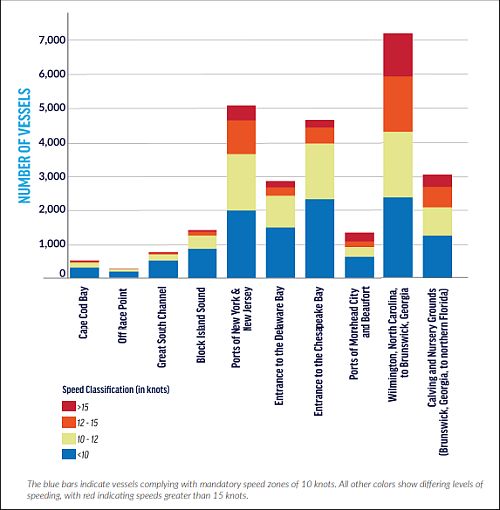
Knot good: Thousands of vessels are speeding through NOAA-mandated 10-knot speed zones, designed to protect endangered marine life. (Source: Oceana)
While Oceana’s 42-page analysis contains no specific data about right whale collisions in Long Island waters, the world’s most endangered whale species is out there, according to Singer, who noted the docile, surface-skimming coast-huggers – averaging about 50 feet in length and upwards of 70 tons – “have definitely been spotted off New York and Long Island.”
“They pass through the New York area on their migratory route, which is why the Seasonal Management Area is active,” Singer added. “They’re moving from their feeding grounds in Canada to their calving grounds in Florida.”
And while they do, it would be best for seafaring humans – from enormous cargo-ship captains to weekend yachtsmen – to obey NOAA’s Vessel Speed Rule Assessment, according to Brogan, who said “one human-caused death is too many for this population to sustain.”
“If NOAA wants to save this species from extinction, ships must slow down when these whales are present and speeding boats must be held accountable,” Brogan added. “Time is of the essence before North Atlantic right whales reach the point of no return.”