
By GREGORY ZELLER //
Middle-market CEOs are very worried about the potential economic and regulatory impacts of Election 2024.
 That’s the big takeaway from the latest Marcum-Hofstra CEO Survey, the periodic litmus test applied to top executives by New York City-based accounting giant Marcum LLP and Hempstead-based Hofstra University’s Frank G. Zarb School of Business.
Circulated Tuesday, it’s the first Marcum-Hofstra CEO Survey to be released since Marcum announced in September that it had been acquired by Ohio-based business-advisory/CPA firm CBIZ Inc. It’s also the fourth CEO Survey of 2024 – following editions released in July (focused on hiring and retention issues), May (exploring outsourcing issues) and March (reviewing top issues for the year ahead, including the rapidly approaching Presidential election), and the latest in a long-running series dating back to 2019.

Jeffrey Weiner: Brace for impact.
This time, Election 2024 takes center stage, with 90.5 percent of respondents (254 CEOs, vice presidents, managing partners and other execs at companies with revenues ranging from $5 million to $1 billion-plus, contacted by phone in September) indicating they were either “very” or “somewhat” concerned about the state of the national economy – and uncertainty about the upcoming Presidential vote cited as the primary fuel for their angst.
A majority of respondents also cited political uncertainty as a major worry, with 51.6 percent counting it among their top three concerns.
That’s more than the 48.5 percent who listed a potential economic slowdown as a top-three concern, but not as substantial as the roughly 75 percent of respondents who listed corporate tax rates, trade policies and international tariffs – all cornerstone issues in the Presidential contest – as a leading anxiety.
Numbers like that reflect “deep concerns over how political changes may influence economic stability and regulation,” according to Marcum Chairman and CEO Jeffrey Weiner.
“With the overwhelming economic and regulatory uncertainties shared by CEOs, it is clear that businesses are bracing for potential upheavals ahead of the 2024 elections,” Weiner added. “Marcum is actively providing strategic advice to help businesses plan and prepare so they can remain focused on growth and innovation in any political landscape.”
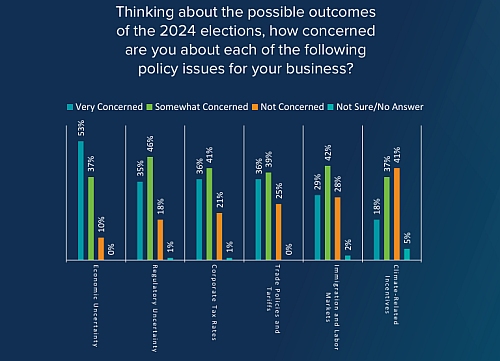
Plenty to worry about: Economic uncertainty, regulatory upheaval, fluctuating corporate tax rates and other issues related to the Presidential election are weighing heavily. (Source: Marcum-Hofstra CEO Survey)
There’s little doubt shifting landscapes are havening a dampening effect on corporate enthusiasm: Only 9.1 percent of responding CEOs rated their 12-month business outlook as “very positive,” down from 13.9 percent in the survey released in July, which queried CEOs during the last week of June.
Optimism was down, survey-to-survey, across all industries: It dropped from 38 percent to 25 percent among respondents in the financial services industry, from 58 percent to 30 percent among healthcare executives, from 63 percent to 45 percent among technology-focused leaders and from 62 percent to 27 percent among execs in the wholesale and distribution trades.
More than simply reflecting CEO concerns as the election approaches, the data is evidence “that political outcomes are perceived as directly impacting business operations and planning,” according to Zarb School Associate Professor of International Business and Marketing Andrew Forman, who led the business school students who developed, conducted and analyzed the survey.

Janet Lenaghan: Well prepared.
“This emphasizes the importance of strategic adaptability and resilience in the face of policy changes and economic fluctuations,” Forman said in a statement. “Our survey offers a snapshot of the priorities and challenges that CEOs are currently facing.”
While “economic concerns” were, by far, the No. 1 factor influencing business-planning decisions over the next year, they were not the only issues CEOs are closely monitoring. Roughly 18 percent of respondents listed the availability of talent as their biggest influencer, while 11 percent cited access to capital; changes in technology, rising materials and operational costs, potential cyberattacks and foreign competition also weighed heavily.
As usual, according to Frank G. Zarb School of Business Dean Janet Lenaghan, there are many potential obstacles affecting C-suite outlooks and planning processes – and insights provided by the ongoing Marcum Hofstra CEO survey are “crucial” to preparing future executives to handle those challenges.
“[They] inform our curriculum and ensure that our students are well-equipped to meet the demands of today’s business environment,” Lenaghan noted. “The decline in optimism about the business landscape and the increased focus on economic concerns and talent availability highlights the shifting priorities within the corporate world.
“It is imperative that we equip our students to lead with innovation and resilience,” the dean added, “particularly as political and regulatory uncertainties become more pronounced.”