By GREGORY ZELLER //
Albany’s main economic engine will help fuel the next-generation ion collider slowly taking shape at Brookhaven National Laboratory.
 The Empire State Development Corp., the state’s main economic-development engine, has executed a $100 million Grant Disbursement Agreement targeting BNL’s ambitious, $2.8 billion Electron-Ion Collider project. The long-gestating deal with the U.S. Department of Energy is a giant leap toward bringing the world’s most advanced polarized EIC to Long Island – and marks another milestone moment for the state’s ongoing support of advanced energy, medicine and technology breakthroughs.
Governor Kathy Hochul – who’s made science and technology funding a cornerstone of her annual budget processes, including the $113.7 million Battery-NY initiative centered at Binghamton University, a $30 million state stipend for Farmingdale State College’s new Center for Computer Science and Information Technology and a $6.5 million grant funding quantum Internet experiments at Stony Brook University – announced the GDA Tuesday, trumpeting the advent of a “transformative, one-of-a-kind technology” on Long Island.

Kathy Hochul: A one-of-a-kind investment in Long Island.
“Brookhaven National Laboratory’s Electron-Ion Collider will expand our state’s capability to achieve unimaginable breakthroughs in science, attract innovative 21st Century businesses and create good-paying jobs,” added the governor, who thanked President Joe Biden, New York’s congressional delegation and the Energy Department’s Upton-based laboratory “for their partnership to transform our state into a global hub for innovation.”
The DOE selected BNL as the site for its groundbreaking nuclear physics facility in 2020, with then-U.S. Secretary of Energy Dan Brouillette noting the EIC “promises to keep America in the forefront of nuclear physics research and particle-accelerator technology.”
Following several rounds of negotiations between Albany and the Energy Department, New York’s $100 million investment in the project was finalized in February of this year, with state officials lauding a major-league business-development score.
“The Electron-Ion Collider exemplifies the profound impact of strategic investments in groundbreaking research and development,” noted Empire State Development President, CEO and Commissioner Hope Knight. “This transformative project will serve as a magnet for top talent, catalyze economic growth and pave the way for revolutionary technologies that will define our future.”
The EDC grant disbursement is expected to be spent over the next four years, supporting the design, construction and hardware-installation phases of the project’s first four buildings. A total of 14 new buildings are projected for the entire EIC effort, with construction slated to run through 2033.

Matthew Aracich: Lots to build on.
That’s an awful lot of steady construction work over the next decade, according to Building and Construction Trades Council of Nassau & Suffolk Counties President Matthew Aracich, who said the state investment “will create thousands of rewarding careers for Long Island’s skilled workforce in the building and construction trades and will draw on expertise from … neighboring universities and laboratories around the world.”
“This project does much more than draw people to the region with the promise of rewarding careers,” Aracich said Tuesday. “It is the pebble tossed into a pond whose ripples reach far beyond its initial splash, bringing advancements in essential research and breakthrough technology once thought to be impossible.”
The super-advanced particle accelerator will be designed to collide electrons with protons and atomic nuclei, producing precision three-dimensional snapshots of those particles’ internal structures – like “a CT scanner for atoms,” according to BNL.
In so doing, the electron beam will reveal the arrangement of the quarks and gluons comprising the protons and neutrons of nuclei – tiny keys that could unlock previously unattainable knowledge about the very fabric of the universe.
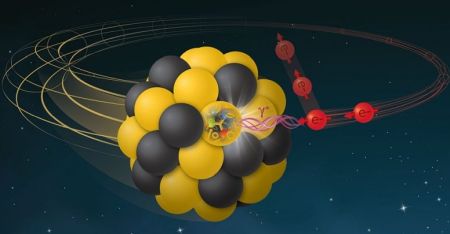
Big secret: The super-advanced Electron-Ion Collider could reveal the fundamental makeup of atomic nuclei — and unlock the secrets of the universe, according to supporters.
The thick science and its myriad applications can be difficult for laypeople to wrap their heads around – but make no mistake, according to U.S. Sen. Chuck Schumer (D-NY), who’s helped secure the billions of dollars required by this effort, the EIC “will keep the United States and Long Island at the forefront of scientific discovery and unlocking the secrets of the universe.”
“This project will create thousands of union construction jobs, juice Long Island’s economy, bring scientists the world over to New York and unleash new technologies that we cannot even begin to imagine,” Schumer said in a statement. “I look forward to working with [Hochul], Lab Director JoAnne Hewett, DOE Secretary (Jennifer) Granholm and the Biden Administration to bring this project to fruition.”