By MARILYNN ELIE //
Aditya Upadhyay wants to change the way you think about satellites.
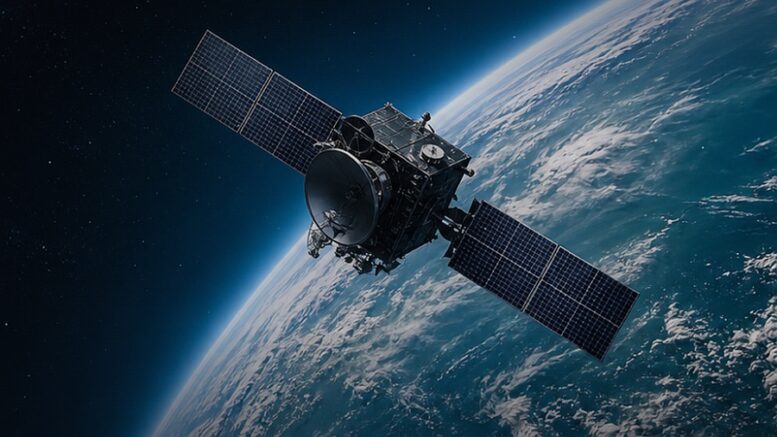
 Satellites quietly shape everyday life. They guide GPS navigation, forecast weather, support emergency responses and enable global communications. Despite this essential role in modern life, however, most people rarely think about them, much less interact with them.
Enter Upadhyay, a Stony Brook University alumnus who founded Oasis Orbital – a 2025 startup aiming to promote visibility of the largely invisible space economy – and created Call A Satellite, a conversational platform that allows earthbound students, educators and museum visitors to beam questions directly to the International Space Station, using artificial intelligence and live orbital data.
What began as an SBU classroom demonstration has expanded into a successful pilot exhibit at Connecticut-based Sacred Heart University’s Discovery Science Center & Planetarium, illustrating a new approach to science education through reach-for-the-stars tech and ground-based curiosity.
Growing up in India, Upadhyay was fascinated by space and the questions it inspired.

Aditya Upadhyay: Space to grow.
“I’ve always been deeply curious about how things work,” he told Innovate Long Island. “I grew up in Mumbai looking up at the sky, wondering what was out there.”
That curiosity eventually brought him to Long Island and SBU, where he studied not astronomy or space mechanics but quantitative economics and theater, a combination that doesn’t necessarily warp straight to the final frontier but did shape Upadhyay’s entrepreneurial journey – and solidified his belief that even the most advanced technologies have little impact if laypeople can’t understand them.
This became the philosophical foundation of Oasis Orbital and its Call A Satellite product. Rather than building another technical dashboard, Upadhyay set out to create a more natural way for people to engage with next-generation science – in this case, satellite data.
His big-picture idea – helping people “just talk to that data” – became his flagship product, boasting a functionality that’s as simple as it gets.
Visitors simply press a button and ask questions: Where is the ISS located? What’s it passing over at this exact moment? How fast is it traveling? The platform responds using live telemetry data, turning complex aerospace concepts into an interactive conversation.
True to Upadhyay’s mission, the platform’s first public test didn’t happen at a technology conference or in front of investors, but in a classroom. Shortly after graduating from Stony Brook last year, the entrepreneur returned to his alma mater to demonstrate an early version of Call A Satellite in Associate Professor Phillip Baldwin’s digital media class.
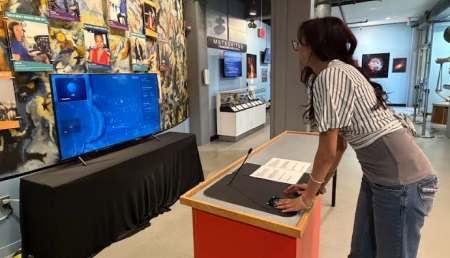
Who you gonna call: The ISS, direct from Sacred Heart University’s Discovery Science Center & Planetarium.
The response to what the inventor called “a more intuitive way to engage with space” was impressive. Baldwin later described the classroom experience as creating “a palpable sense of immediacy and presence,” noting that students naturally progressed from asking simple questions about the ISS to more involved queries about orbital mechanics and aerospace technology.
The teacher also praised the platform’s potential for museums, science centers and other educational environments.
The successful demo quickly opened the door to a broader audience. Call A Satellite was soon featured in a pilot exhibit at Sacred Heart’s Bridgeport-based planetarium, where families, students and visitors have experienced the same curiosity-driven conversations as Baldwin’s students.
For Upadhyay, these interactions have reinforced his platform’s purpose and potential.
“The most rewarding reaction has been seeing how quickly visitors move beyond basic questions and become genuinely curious,” he said.
While artificial intelligence applications often raise concerns about replacing traditional learning, Upadhyay believes AI can be used to encourage exploration, support educators and help students ask better questions – instead of simply learning to deliver the right answers.
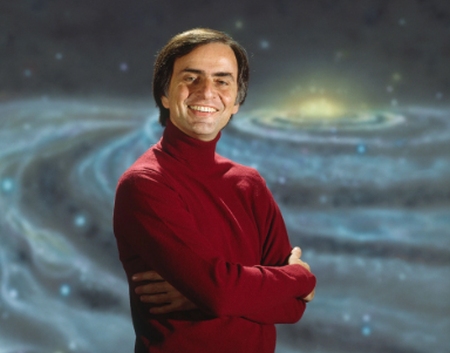
Hailing frequencies open: Astronomer Carl Sagan was a brilliant science communicator — and a science-for-the-people inspiration for entrepreneur Upadhyay.
Like many first-time founders, he acknowledges his entrepreneurial journey’s many challenges – in particular, proving that the technology represents more than a novelty. What keeps him motivated is seeing people engage with science in ways they had never experienced before.
He hopes Oasis Orbital will expand into additional museums, science centers and educational institutions while growing into a broader platform that helps people understand Earth observation systems, space debris and the satellite infrastructure that quietly shapes everyday life.
The avid hiker and sailor and self-taught pianist credits Steve Jobs as an inspiration – for demonstrating how technology, design and storytelling can work together – and says the late Carl Sagan continues to inspire the way he communicates science to everyday audiences.
His personal motto, passed down from his parents, is simplicity in action: “Do it now.” And it could carry him and his creation to classrooms and science centers around the world.
“We’re building a way for anyone to ask questions and understand what is happening above them,” Upadhyay said. “And feel connected to space in real time.”