By TERRY LYNAM //
To those who’ve lost a loved one, it’s blood money: $55 billion in court settlements to be paid out in response to the 900,000 American lives lost over the past 25 years to opioid-related overdoses.
 Here’s the gnawing question: Is this money – including about $2.8 billion ultimately earmarked for New York State – being distributed fairly?
Is it being spent in ways that will truly help people who are suffering with addiction and prevent others from suffering the same fate?
Skeptics reference the $246 billion settlement state attorneys general reached in 1998 with the country’s four largest tobacco companies. Despite that massive payout, few strings were attached to how states could spend the money – and as a result, little is known about where the funds have gone over the past 25 years.
In a 2021 interview, Harvard University History of Science Professor Allan Brandt, author of “The Cigarette Century: The Rise, Fall and Deadly Persistence of the Product that Defined America,” lamented “a notorious example of collecting a lot of funds through litigation, but not getting those funds to those who most need or deserve them.”
Terry Lynam: Allocation consternation.
“The $246 million was used to fill budget gaps, build roads and for other purposes,” Brandt said in the interview. “Only very rarely was it used for any form of public health, let alone reducing tobacco use, treating those who were addicted and protecting kids from becoming smokers.
“I think a lot of people have watched the emergence of the opioid litigation with the tobacco-settlement cloud hanging over the proceedings.”
Those responsible for divvying up the opioid-settlement funds say it will be different this time.
The money is coming from settlements with Johnson & Johnson, Teva Pharmaceuticals, Allergan, Mallinckrodt Pharmaceuticals and Endo International, all of whom manufactured addictive painkillers like oxycodone and hydrocodone. Also on the hook are companies that distributed the drugs to physicians and pharmacies and retail pharmacies including CVS, Walgreens, Walmart and Kroger.
Global consulting giant McKinsey & Company has also been lumped in, for helping Purdue Pharma “turbocharge” sales of OxyContin. In June, the U.S. Supreme Court scuttled Purdue’s $6 billion settlement agreement, ruling that it inappropriately shielded members of the Sackler family, the company’s former owners, from legal claims by opioid victims.
States have set up their own administrative structures and processes to distribute the money, and while individual states and local governments have significant leeway in how they allocate their cut, the national settlement requires that at least 70 percent be spent on “opioid remediation efforts” over the next 18 years.
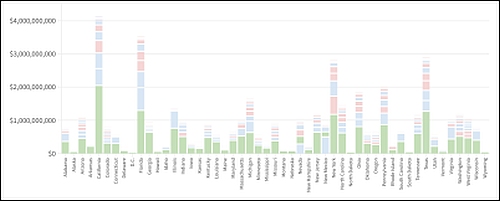
On track?: New York State is projected to receive roughly $2.8 billion in opioid-settlement funds — but debate rages over the best use of those funds. (Source: OpioidSettlementTracker.com)
In New York State, 46 percent of the settlement funds are being funneled to local governments, 37 percent to an opioid-settlement fund that invests in programs overseen by the state Office of Addiction Services and Supports (and other agencies, based on an advisory board’s nonbinding recommendations to the State Legislature), and about 17 percent to a discretionary fund administered by State Attorney General Letitia James, who negotiated the New York’s settlement agreement.
This has not been a “kumbaya” process. Earlier this month, the state’s Opioid Settlement Fund Advisory Board issued a report criticizing OASAS and other state agencies for withholding information needed to make well-informed funding recommendations and failing to provide data evaluating the effectiveness of programs receiving money.
On Long Island, which is projected to receive hundreds of millions of opioid-settlement dollars, the distribution process and funding decisions have been similarly contentious.
Jeffrey Reynolds: Crisis management.
Nassau County has already received more than $92 million in settlement money, and County Executive Bruce Blakeman – who controls the funding decisions – has pledged to allocate $15 million a year toward drug prevention, education and treatment. But aside from a February news conference where he awarded $6.8 million in grants, Blakeman has made no other grant announcements this year.
Nassau County Legislature Democratic Minority Leader Delia DeRiggi-Whitton has criticized the slow pace of allocations, calling it an “insult to every family that continues to struggle with the opioid epidemic.”
There has also been controversy in Suffolk County, which distributed $57 million in grants in 2022-23 based on recommendations of a county task force comprised of former County Executive Steve Bellone, the county legislators, the county health commissioner and a victim’s advocate. But less than four months after taking office last January, County Executive Edward Romaine questioned the legitimacy of the decision-making process, because four former county officials – including Bellone – later went to work for organizations that received opioid grants.
Soon afterwards, County Comptroller John Kennedy Jr. announced plans to audit Suffolk’s opioid-settlement fund. Meanwhile, transparency concerns have prompted the state’s Opioid Settlement Fund Advisory Board to demand that both Nassau and Suffolk – as well as New York City – reveal more details on how they’re spending the money.
All told, New York State has already allocated more than $366 million, prioritizing investments in substance-use prevention and treatment, harm reduction and support for people in recovery. That obviously makes sense.
But there were more than 81,000 opioid-related deaths nationwide in 2023, including 5,186 in New York State and 559 on Long Island (389 in Suffolk, 170 in Nassau). The severity of the crisis demands that state and local leaders stop the political haggling and get more money out the door as soon as possible.
It’s not about scoring political points, according to Family & Children’s Association President and CEO Jeffrey Reynolds, but a basic healthcare mandate – for current and future Long Islanders.
“These are the dollars that are going to help us do the work necessary to get us out of this crisis,” Reynolds says. “They will have a multi-generational impact.”
Terry Lynam is a communications consultant and former senior vice president/chief public relations officer for Northwell Health.