By GREGORY ZELLER //
A New York City-based energy-efficiency innovator is earning rave reviews from PSEG Long Island for its cutting-edge approach to HVAC productivity – potentially huge news for the nation’s burgeoning data centers.
 Meet Enercoat, a unique substance manufactured by Ener.co LLC, a 2009 startup dedicated to energy-conservation measures – particularly through its flagship product, a “thermal coating” for finned air-cooled heat exchangers.
So far, so mundane – until you realize that such coils are present inside virtually every commercial and industrial HVAC and refrigeration system – including those used to condition environments inside server farms and other data centers, where frigid temperatures are essential to proper operation.
That makes Enercoat a godsend across multiple industries – and made Ener.co’s breakthrough offering the clear choice when hybrid cloud services provider Opti9 Tech updated critical cooling equipment at its Garden City facility (the former JetBlue operations center on Franklin Avenue) two years ago.
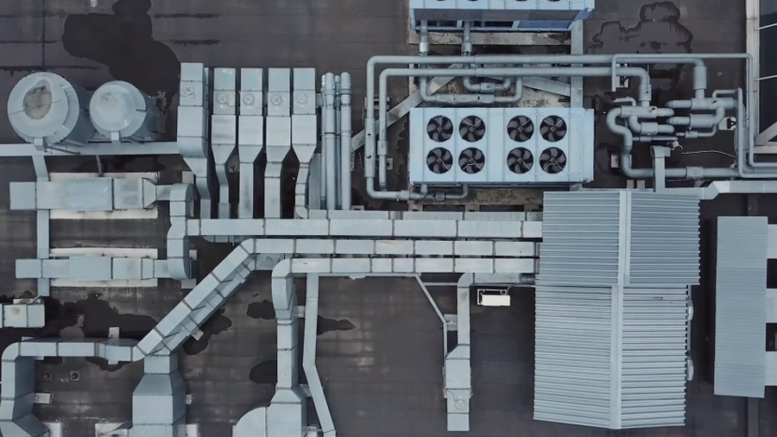
Specifically, Ener.co retrofitted nine rooftop-mounted Computer Room Air Conditioning units. Ranging in age from nearly 20 years to roughly five years, all nine units had lived past their operational prime – a common scenario at domestic data centers, according to Ener.co Business Development Director Mark Larson.

Mark Larson: Anti-corrosion crusader.
“A data center is critical infrastructure and must guarantee near 100 percent reliability, and the computer servers generate a lot of heat that must be removed,” Larson noted. “Air conditioning is used year-round and it is essential.
“From the moment a coil goes into service, especially on a salty-air Long Island rooftop, it begins to corrode,” he added. “The aluminum fins lose contact with the copper refrigerant tubes, and that microscopic separation gradually strips away thermal efficiency year after year.”
Enter Enercoat, which was formulated by Ener.co founder Patrick Rathje and thoroughly field-tested before Rathje launched his startup 17 years ago. The application and measurement/verification processes of the graphene-powered polymer coating have been consistently refined ever since.
Conventional cleaning methods remove dirt from AC coils but can’t reverse corrosion, which compounds annually and continuously saps a unit’s efficiency. Worse yet, according to Larson, “aggressive chemical cleaning often accelerates” the corrosion process.
Rathje, the son of a heat-exchange engineer, knew from the start he had a technological winner with his polymer solution – though he still faced an uphill battle to mainstream his promising product.
“No participant in the traditional building-services market had a financial incentive to arrest coil degradation,” Larson noted. “Manufacturers want to sell new equipment and service companies want service calls, so there is little incentive to preserve equipment that is already in place.”
But “we feel that building owners and operators would disagree” – a theory that has proved out over the better part of two decades, according to Larson, who cites Ener.Co’s tentpole Garden City project as Exhibit A.
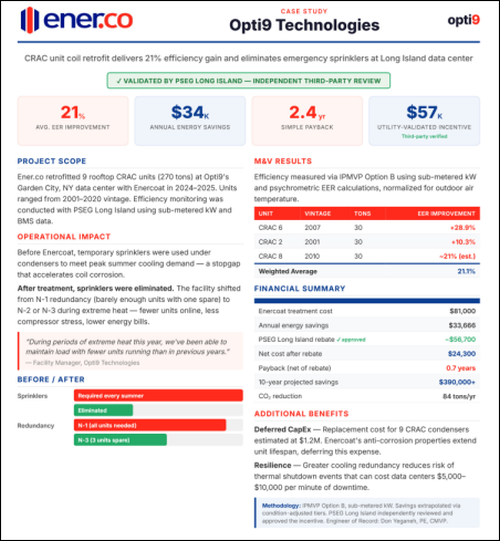
Plan Opti9: According to independent auditors, Ener.co’s work in Garden City has provided considerable economic and environmental advantages. (Source: Ener.co)
In a nutshell, Ener.co technicians clean AC coils down to their bare metal, straighten any damaged fins (to restore and maximize airflow) and apply the Enercoat. In addition to being thermally conductive, the graphene-infused glop fills microscopic gaps between fins and coils, preventing the spread of new corrosion.
The results can be impressive. An Ener.co case study of the Opti9 project, validated independently by PSEG Long Island, showed that Opti9 not only eliminated a temporary sprinkler/condenser setup it cobbled together to cool its Garden City data center, but saved $34,000 in annual energy costs – meaning the rooftop redux will pay for itself inside of three years.
With a host of large-scale clients under its belt – and more than 75,000 tons of “treated cooling capacity” to date, according to Larson, covering clients as diverse as The New York Times, Verizon, the Massachusetts-based Baystate Health system and others – Ener.co believes it can provide similar advantages to businesses across Long Island.
We have among the highest electric rates in the nation, and we are surrounded by salt water,” Larson told Innovate Long Island. “The salty air speeds up the corrosion that Enercoat is designed to stop, which means the savings are larger and the equipment life extension is greater than in other parts of the country.
“Every bit of efficiency we recover goes right to our clients’ bottom lines,” he added. “And as rates go up, this value grows as well.
“It’s an all-around environmental and efficiency win.”