By GREGORY ZELLER //
What’s old is new at the Commercial Industrial Brokers Society of Long Island, which dove deep Wednesday into the “adaptive reuse” phenomenon.
 More than 125 society members and other industry experts gathered at RXR Plaza in Melville for “From Vacancy to Vitality: Adaptive Reuse on Long Island,” a high-level panel discussion focused on the transformation of underutilized and obsolete properties into economically productive real estate assets.
Moderated by Forchelli Deegan Terrana Partner Andrea Tsoukalas Curto, the panel – including Combined Resources Consulting and Design President Salvatore Ferrara, R&M Engineering President Christopher Robinson, Mojo Stumer Associates Partner Joe Yacobellis and Kathleen Deegan Dickson, co-chairwoman of Forchelli Deegan Terrana’s Land Use & Zoning Practice Group – flexed its considerable design, engineering and zoning muscle while discussing a multitude of adaptive-reuse benefits currently infusing regional socioeconomics.
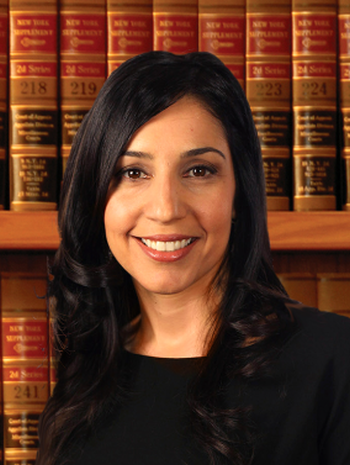
Andrea Tsoukalas Curto: Reshaping communities.
Adaptive reuse – the process of repurposing old, obsolete or vacant structures for modern, economically aware uses, while preserving each structure’s historical or architectural character – is certainly in vogue across Long Island.
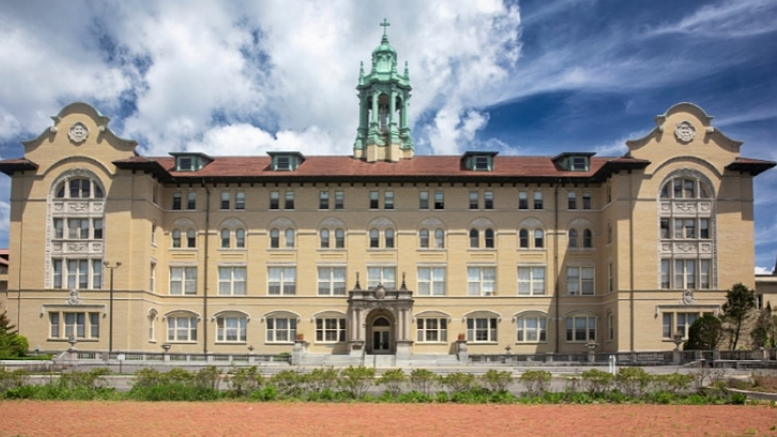
From large-scale projects (the reforming of Holbrook’s zombified SunVet mall into an open-air retail center anchored by mixed-retail convenience) to medium-range redevelopments (the transformation of Brentwood’s century-old Academy of St. Joseph Catholic school into an affordable housing complex for seniors, veterans and the local workforce) to smaller-scale efforts (a former Greenport laundromat remade into a chic live-work loft), adaptive reuse has found a home on Long Island.
Basically, it had to – open land is scarce on the Island, obsolete strip malls are plentiful and a bona fide housing crisis remains in full effect. Straight-up redevelopment (the razing of the old and construction of the new) has its place, of course, but adaptive reuse often provides a cost-efficient and aesthetically acceptable alternative.
Those are not minor considerations in an age of economic uncertainty, with legendary Long Island NIMBYism still holding sway – and they make adaptive reuse “one of the most important conversations in real estate today,” according to Curto, who stressed that “necessity is the mother of invention – and in this case, reinvention.”
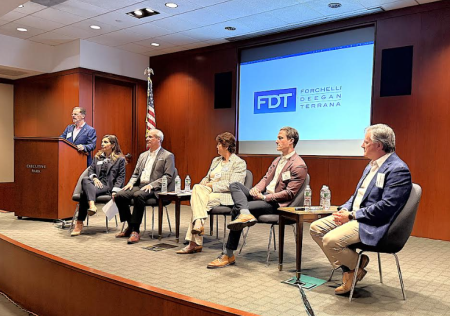
Up for adaption: Panelists discuss adaptive reuse Wednesday at RXR Plaza.
“[The panelists are] an exceptional group of professionals who are not just discussing trends but actively helping to reshape properties and redefine how they serve our communities,” the moderator added.
Among the hot topics discussed Wednesday were evolving market conditions, changing tenant expectations and shifting government regulations, all driving new approaches to redevelopment across commercial and residential real estate sectors.
And the “strong turnout” at the panel discussion “reflects the level of engagement we’re seeing across Long Island around the future of our industry,” according to CIBS President Ralph Benzakein.
“At CIBS, our goal is to bring together professionals for conversations like this,” added Benzakein, also a senior vice president at the Melville office of Chicago-based commercial real estate king Cresa. “[They can] share insights, foster collaboration and help our members stay ahead of the trends shaping commercial real estate.”