
By TERRY LYNAM //
Whether it’s a physician network or an insurance provider or a pharmaceutical manufacturer, the key to success in the ultra-competitive healthcare environment is to get bigger – through mergers, acquisitions and other consolidations aimed at grabbing a larger share of a $5.3 trillion-plus national industry.
 That’s why more health insurance companies and corporate entities are buying up physician practices and pharmacy benefit managers – intermediaries in a $700 billion-per-year pharmaceutical supply chain that manages prescription drug benefits for insurers, employers and labor unions.
To address rampant healthcare-industry consolidation, there’s a bipartisan effort afoot in Congress, aptly called the “Break Up Big Medicine Act.”
Whether it has a prayer of passing is highly debatable, given the influence of the insurance and Big Pharma lobbies. But the mere fact that both Democrats and Republicans are targeting what critics view as “too big to care” corporate monopolies speaks to Americans’ growing resentment against spiraling insurance premiums and out-of-pocket medical bills.
The movement unites two unlikely allies: U.S. Sens. Josh Hawley (R-Missouri), a social conservative and Trump ally, and Elizabeth Warren (D-Massachusetts), a leader of her party’s progressive flank and a fierce critic of the president.
“There’s no question that massive healthcare companies have created layers of complexity to jack up the price of everything from prescription drugs to a visit to the doctor,” Warren said in a recent news release. “The only way to make healthcare more affordable is to break up these healthcare conglomerates.”
Terry Lynam: Structural integrity.
Co-sponsor Hawley added, “In their quest to put profits over people, Big Pharma and the insurance companies continue to gobble up every independent healthcare provider and pharmacy they can find.”
As of 2024, nearly four out of five U.S. physicians were employed by hospitals, health systems, insurance companies or other corporate entities. As of late 2023, UnitedHealth Group’s Optum subsidiary employed or was affiliated with about 90,000 U.S. doctors – roughly 10 percent of the nation’s physician workforce.
To be fair, there’s also a growing number of hospital-owned insurance companies in this country – Kaiser Permanente, University of Pittsburgh Medical Center Health Plan and Geisinger Health Plan are among the largest.
And health systems and hospitals of all sizes have also been aggressively buying up physician practices. Today, they employ about 47 percent of the nation’s physician practices, up from 30 percent in 2012.
But a 2025 report by the American Hospital Association found that commercial insurers acquired 40 percent more physicians than hospitals from 2019 to 2024, while corporate entities like Amazon One Medical and Walgreens bought out twice as many physicians as hospitals.
Insurers and corporate conglomerates have also managed to get a huge slice of the pharma market: As of 2024, about 80 percent of all U.S. prescription drug claims were processed by CVS Caremark, Express Scripts (owned by The Cigna Group) and Optum. And half of every dollar spent on prescription drugs in this country goes to health-insurance companies, pharmacy benefit managers, big pharmacy chains and/or drug wholesalers – all middlemen in the drug-distribution system.
Consumer advocates view insurance companies and PBMs as monopolistic conglomerates that are gouging patients, workers, taxpayers, employers, unions and independent providers. They also decry that these conglomerates steer patients to their own subsidiaries, thereby squeezing independent medical practices and pharmacies and gaming federal regulations designed to cap profits.
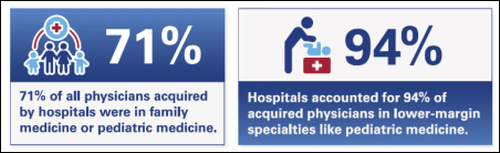
Just their type: Hospitals and healthcare systems are working hard to scoop up private pediatricians and other family-medicine specialists. (Source: American Hospital Association)
As a business model, this is known as “vertical integration,” meaning companies want to control as many pieces of the healthcare supply chain as possible, from the physicians to the pharmacists to the insurers.
By controlling both the insurers that pay for healthcare services and the medical providers who set the prices, these conglomerates “may be steering business to their own affiliates, evading laws intended to rein in corporate profiteering or using providers they employ to boost government payments and pad their bottom lines,” according to Warren and Hawley.
Among other things, the Break Up Big Medicine Bill would prohibit a company from owning both a PBM or an insurer and a healthcare provider or management-services organization (which provides non-clinical administrative or operational services to medical practices). It would also prohibit a prescription drug company or medical device wholesaler from owning a healthcare provider or MSO.
The bill would mandate divestment within one year and empower the Federal Trade Commission, the U.S. Department of Health & Human Services, the U.S. Department of Justice and state attorneys general to bring legal action against violators.

Mark Cuban: Divestment investment.
“For decades, policymakers in both parties have incentivized healthcare consolidation, resulting in Big Medicine behemoths that exploit conflicts of interest to drive costs up, quality down and independent providers out of business,” Emma Freer, a senior policy analyst for healthcare at the American Economic Liberties Project, which supports the Break Up Big Medicine Bill, said in a statement.
The legislation has also gotten a boost from entrepreneur and television personality Mark Cuban, co-founder of Cost Plus Drug Company, a generic drug distributor that has removed PBMs from the process. Cuban said recently on X: “Break up the biggest insurance companies. Make them divest non-insurance companies. They don’t need thousands of subsidiaries.
“That’s how they game and abuse the system and increase costs for all of us.”
As Congress debates the bill, some states are already taking action. Last year, Arkansas became the first state to prohibit PBMs from owning pharmacies – but a lawsuit by PBMs has delayed implementation of the new law.
Seven other states – California, Indiana, Massachusetts, Maine, New Mexico, Oregon and Washington – approved laws last year imposing structural guardrails on healthcare acquisitions.
The fact that the movement against Big Medicine is gaining bipartisan traction at the federal level – and support within both red and blue states – could be a sign that structural changes in the nation’s convoluted healthcare system are finally coming.
Terry Lynam is a communications consultant and former senior vice president/chief public relations officer for Northwell Health.