By GREGORY ZELLER //
Long Island has a wealth of workforce-development initiatives designed to transition experienced professionals into industries that need their help, and plenty of world-class universities with indigenous workforce programs aiming to place future graduates on their best career paths.
 But what about high school students?
According to partners Kyle Moeller, Neil Rasmus and Leo Sternlicht, the development of future workforces should start earlier than the university level. Helping younger professionals-in-waiting get a grip on their professional prospects, they say, is better for entire industries, individual companies and – most importantly – the students themselves.
Enter Risers, an ambitious 2023 startup founded by the trio to address an issue Moeller, a corporate-finance professional by trade, first noticed during the COVID pandemic, but actually runs much deeper.
“Walking around on Main Street, with all the store owners struggling to keep their businesses open and keep the lights on, I saw there was a similar gap for students looking for their first work experiences, but being stuck at home,” the co-founder and CEO told Innovate Long Island. “Businesses needed their help.”
Stony Brook-based Risers’ solution is sweet and simple: career exploration for teenagers, an historically underserved population in this specific regard.
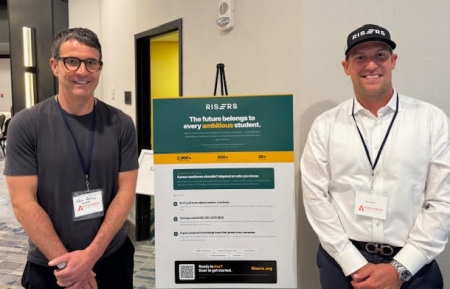
School of thought: Partners Neil Rasmus (left), Kyle Moeller and Leo Sternlicht (not pictured) are going back to high school on a workforce-development rescue mission.
“Right now, you have LinkedIn out there for working professionals in the wild – it’s very much social and it’s the one everybody knows,” Moeller noted. “Then you have Handshake, which is mostly for college students looking for internships and trying to figure out what they’re going to do after (college).
“Risers goes downstream to the high school student, before they choose a college or a career and make these life-impacting decisions,” he added. “We help them get their first taste of professional experience.”
To do that, the Risers team has become a broker, of sorts, between school districts – Hauppauge High School and East Setauket’s Ward Melville High School have been its pilot schools – and an already-impressive selection of industry partners. While Moeller et al continue to enlist professional firms across numerous industries, heavy hitters including PricewaterhouseCoopers, Grassi Advisory Group, Coach Realtors and H2M architects + engineers, among others, have already enlisted.
Those partners bring a wide range of part-time and volunteer opportunities to the table – but Risers’ career-exploration mantra might be best illustrated by its “shadowing” opportunities, which place high schoolers on the front lines of various industries, trailing professionals through their busy workdays.
“The career-exploration opportunities come in a variety of forms,” Moeller said. “But the most popular form is our ‘shadow day’ experiences.”
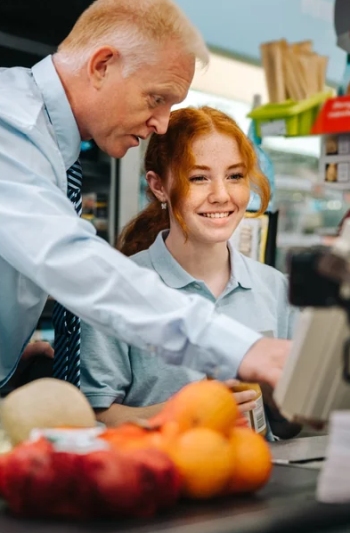
Level up: Students benefit from part-time jobs, volunteer work and other opportunities at grocery stores, major corporations and everywhere in between.
Participating students also take part in a five-minute survey that collates their skills, hobbies and career interests – “maybe one (career), maybe a few,” Moeller noted. With that information in hand, the Risers team creates a “digital opportunity” flowchart and applies it to their local, national and international industry partners, looking for the best possible matches.
“We go to them and say, ‘We’ve got a student interested in doing X, Y or Z – whether it’s accounting, or biotech, or whatever – and we set them up with a 30-minute Zoom with a hedge fund manager, or a three-hour in-person meet-and-greet with a Big Four auditing firm,” the CEO added. “Whatever might work.”
For the students, it becomes an invaluable peek at possible futures. Just as important as learning the ropes of what they believe is their best career, according to Moeller, is realizing a certain path is maybe not the best idea.
“It validates their career interests or it doesn’t,” the CEO noted. “But 100 percent of them come back and say it will impact the decisions they make and what they’ll do.”
The industry partners, meanwhile, get a better-than-average chance of establishing effective, highly localized employment pipelines – and the satisfaction of helping youngsters find their way.
Moeller is particularly fond of a famous story about late, great Apple and Pixar cofounder Steve Jobs, who as a 12-year-old boldly cold-called Hewlett Packard co-founder Bill Hewlett to ask for spare parts to build a frequency counter. (Hewlett was so impressed by the boy’s initiative that he offered Jobs a summer job.)
“If you ask people for help, more likely than not they will help,” Moeller said. “We don’t ask the companies for money – we’re asking them to share their career insights.
“This is all about helping the students.”
The professional paths taken by the three Risers cofounders – Moeller is also a corporate banking managing director at Capital One, Rasmus is a founding partner of New York City-based media-focused photography studio BFA, Sternlicht is a BFA partner with extensive coding and design experience – also inform their business-development approach.
Among other things, all three appreciate the power of word-of-mouth marketing, which they incorporate in their business model – and leverage into another on-the-job training opportunity for students.
“We hire interns from every high school we partner with,” Moeller noted. “We want them to be our boots on the ground and be our district ambassadors.
“They help spread word amongst the faculty, the guidance counselors and the career-oriented classes,” he added. “And we give them sales, marketing and corporate-communications experience.”
Supported by the Accelerate Long Island Innovation Hot Spot program at SBU, Risers is spending its Summer vacation discussing new collaborations with additional Long Island high schools. The plan is to establish partnerships in 10 total districts within the next six months; after that, expansion to other regional schools (and schools beyond Long Island) will “happen organically,” according to Moeller.
“We want to build and the next big thing is expanding our team and scaling organically,” he said. “We’ve already talked to folks in Connecticut and we’ve talked to some ed-tech industry partners that have a need or interest in going downstream to educate students.”
Wherever Risers goes next, “the most important thing is making sure we’re doing it right and maintaining that level of service and quality,” Moeller said – and giving younger future professionals the tools they need to drill down on their chosen careers and make the smartest choices.
“They’re not yet at a fork in the road where they have to make those big decisions, like selecting a major or applying for jobs,” the entrepreneur said. “It’s more about ‘maybe there’s a target school I should focus on,’ or ‘maybe there’s an interview list I should be thinking about.’
“Everybody’s experience is unique,” Moeller added. “The idea is connecting ambitious students that want these opportunities with industry partners who want to help.”