


By DAVID A. CHAUVIN //
Every few weeks, I’m reminded that I’m not nearly as clever as I’d like.
 It usually happens at a red light. I’ll glance over at a storefront with a business name so ingenious that I laugh out loud. Maybe it’s a barber shop or a deli or a neighborhood café – whatever. My first reaction is usually a smile, and my second is almost always the same thought: “Why didn’t I think of that?”
Confession: I’m jealous of clever people. Not necessarily people with the highest IQs or the longest résumés. I mean genuinely clever people – the ones who hear a phrase and instantly find the joke everyone else missed or take a mistake and turn it into an opportunity.
The people who look at the exact same problem the rest of us are staring at and come up with a solution so simple and unexpected that it feels obvious – but only after they’ve thought of it.
I had that reaction recently while reading about the New Bedford Whaling Museum. A visitor left a one-star review online, calling it the “world’s worst aquarium,” but instead of ignoring the review or demanding it be removed, the Massachusetts museum – which is not an aquarium at all – embraced it.
They printed T-shirts proclaiming themselves the “World’s Worst Aquarium” and sold them in the gift shop. What could have been an embarrassing online moment became a viral marketing campaign, attracting national attention and driving merchandise sales.

David Chauvin: Clever like a fox.
That’s clever. And it’s exactly the kind of idea that makes me wish my brain worked that way.
I’ve spent much of my career in communications, and one lesson keeps proving itself: Clever almost always beats expensive.
The organizations that break through aren’t always the ones with the biggest advertising budgets. They’re the ones that see the opportunities everyone else overlooks.
For years, communications professionals chased the next advantage. It was SEO. Then it was social media. Then it was the perfect hashtag.
Today, it’s artificial intelligence, which can draft a press release, write a speech, brainstorm headlines and summarize research in seconds. Those are remarkable tools, and I use them regularly.
But AI struggles to produce the ideas that make someone stop scrolling long enough to laugh or smile or share what they’re seeing with a friend.
It’s the same for business as it is for marketing and content development.
In April 2025, digital language-learning platform Duolingo issued a now-infamous “AI-first first” memo announcing it would phase out contractors for work AI could handle. The backlash from users was swift. Users questioned if automated content could handle the regional dialects and cultural authenticity of human-led teaching.
Duolingo CEO Luis von Ahn later insisted the memo was misinterpreted. Nonetheless, shortly after issuing its fourth-quarter 2025 earnings report, the company saw its stock collapse, with investors dumping the stock not because of the financials, but because of the forward guidance the company issued regarding a heavy reliance on AI.

Luis von Ahn: Duolingo do-over.
The lesson is that AI is an extraordinary tool, but without human judgment, creativity and clear communication guiding it, even a beloved brand can lose its way.
Cleverness isn’t just about information. It’s about perspective. It’s about seeing possibility where everyone else sees a problem. It’s understanding people well enough to know that authenticity is often more powerful than perfection, and recognizing that the best response to a bad review isn’t always a lawyer or a carefully worded statement.
Sometimes, it’s a T-shirt.
As technology makes competence easier to achieve, creativity becomes even more valuable. When everyone has access to the same tools, the advantage shifts to the people who think differently.
That’s good news for Long Island. In fact, Long Island may have invented this kind of cleverness.
Back in 1931, a Riverhead duck farmer named Martin Maurer wanted passing motorists to stop and buy his ducks and eggs. He didn’t have an advertising budget. So, he built his shop in the shape of a giant duck (modeled after a roadside coffee shop in California shaped like a giant coffee pot).
The Big Duck worked. Drivers stopped. The farm thrived. And the building became so famous that architects later coined an entire term to describe structures shaped like what they sell – “duck architecture.”
Nearly a century later, the Big Duck still stands in Flanders, a beloved landmark and a listed historic place. Think about that: No integrated marketing campaign, just a push so clever that it entered the architectural vocabulary and outlived nearly every advertising campaign of its era.
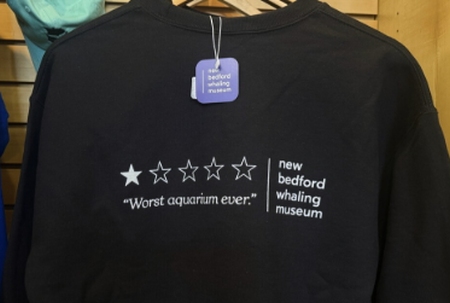
Lemonade from lemons: Instead of wailing about it, the New Bedford Whaling Museum turned a bad online review into a viral marketing campaign.
AI could have helped develop the blueprints to build the duck or perhaps make suggestions on the height of the structure or hue of the paint, based on local preferences and ordinances. But the idea itself was everything.
That spirit hasn’t gone anywhere. Our region has never competed by outspending everyone else. We’ve built businesses through ingenuity, relationships and resourcefulness. Whether it’s a startup in Huntington, a family business in Farmingdale or a nonprofit finding a new way to engage its community, some of the best ideas aren’t the most expensive – they’re simply the cleverest.
Maybe that’s why I’ve always admired clever people. They don’t just think faster. They think differently, turn criticism into conversation, transform ordinary ideas into memorable ones.
And every once in a while, they create something so unexpectedly perfect that the rest of us stop, smile and offer what may be the highest compliment in business:
“Why didn’t I think of that?”
David A. Chauvin is executive vice president of ZE Creative Communications.





David, I think you may have disproved your own premise. For someone who claims to be jealous of clever people, turning the Big Duck, the world’s worst aquarium, and Duolingo into the same marketing lesson is annoyingly clever.
And as Long Island marketing lessons go, maybe you don’t always need all your ducks in a row. Sometimes one enormous duck will do!