

By FRANK PICCININNI //
Anyone who’s spent enough time in Long Island land-use hearings knows the routine.
 A developer proposes to clear a site. Mature native trees come down. Wetlands are filled or altered. Ground is paved over. Drainage patterns change. The project transforms the landscape.
Then comes the wastewater presentation.
An innovative advanced septic system will remove nitrogen. The technology is sophisticated. The numbers look good and the project is presented as an environmental improvement.
This is where the discussion often narrows. The developer hangs his or her hat on nitrogen removal, and the board is left with a simple talking point: Nitrogen equals wastewater.
Better wastewater treatment means less nitrogen, and less nitrogen means an environmental benefit. Case closed.
Except it isn’t.
Wastewater treatment matters. Long Island’s conventional septic systems and cesspools have contributed nitrogen to groundwater for generations. Advanced onsite treatment and centralized wastewater treatment can reduce those inputs. We need the technology and the investment.

Frank Piccininni: Wastewater worries.
But nitrogen is not synonymous with wastewater. Years of public discussion have understandably put wastewater at the center of the nitrogen problem. The danger is that a major source becomes the entire story. When the message is wastewater, wastewater, wastewater, other factors shaping nitrogen loading, fate and transport can disappear from view.
More fundamentally, even wastewater treatment relies on nature. Advanced onsite systems often bring nitrogen concentrations below a regulatory standard, but efficacy still depends on biological processes in the soil.
The technology does not operate independently of the environment; it depends on the environment to do part of the work. Yet discussion often stops at the system’s performance specifications, as though a number on a treatment report answers the larger ecological question.
Nitrogen’s source, fate and movement are all but ignored. Where does it originate? What happens as it moves through soil and groundwater? Where is it retained, transformed or carried away? How do clearing, filling, paving and changes in hydrology alter those processes? These questions are readily answerable by project proponents but are rarely asked.
Land-use boards are routinely asked to evaluate complicated projects under difficult conditions. They hear from engineers, planners, attorneys and consultants, each presenting a piece of the picture. The wastewater system may be analyzed in considerable detail through the lens of its projected nitrogen removal. The biological processes on which treatment depends, and the broader pathways by which nitrogen moves through the landscape, receive far less integrated consideration.
The problem is not that board members are indifferent to the environment. It’s that a narrow accounting offers an easy answer to a complicated question.
Demonstrating that a proposed system removes a substantial percentage of wastewater nitrogen does not establish that the development will reduce total nitrogen loading or improve water quality. Nor does it mean that filling a wetland or removing mature native vegetation has no environmental consequence.
New York State’s Long Island Nitrogen Action Plan recognizes an important complication: Improved wastewater treatment can enable greater development density, potentially offsetting anticipated reductions in nitrogen loading.
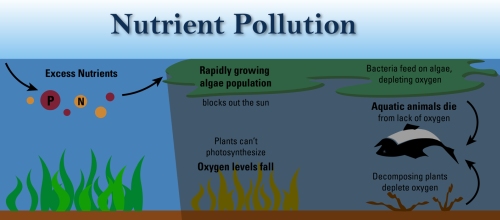
It’s all connected: Pollution by excess nutrients, including nitrogen, is a complicated web that can’t be easily paved over. (Source: U.S. Geological Survey)
More development also means more impervious surfaces and changes to the movement of stormwater through the landscape.
The accounting must include both the nitrogen removed by the technology and the effects of development on the natural processes that make treatment possible.
Long Island’s water quality remains seriously impaired, despite years of attention and substantial investment. Harmful algal blooms, low-oxygen conditions and fish kills continue to affect our coastal waters.
Research on Long Island’s coastal waters documents the persistence and scale of these problems. This doesn’t mean wastewater upgrades are futile; it means we should be asking whether the public conversation, and the land-use decisions shaped by it, adequately account for the larger system that determines their environmental benefit.
Advanced wastewater treatment is necessary. It is not a universal environmental waiver. Reducing nitrogen from one source does not substitute for evaluating cumulative loading, altered hydrology, lost habitat and the ecological functions of the land being developed.
A whole project must be evaluated, not just its wastewater system. The real question is whether the development, taken as a whole, will improve environmental conditions or make them worse.
Nitrogen is a serious problem and wastewater treatment is an essential part of addressing it. The performance of a treatment system, however, is not a proxy for the environmental performance of an entire development. Until we evaluate development this way, we will merely be treading polluted water.
Environmental attorney Frank Piccininni is the co-founder and vice president of the Long Island Conservancy and the cofounder and president of Spadefoot Ecosystem Solutions.





Be the first to comment on "In development, nitrogen is more than a talking point"