By BRAD CARLSON //
Streaming is one of those modern miracles we’ve already normalized.
 Click on a song, it plays. Click on a movie, it starts before the popcorn is hot. Join a video call, and after a traditional “Can you hear me now?” exchange, you’re face-to-face with someone across town or across the world.
The Internet that makes all this possible is built on packet switching. Instead of sending information as one long, fragile stream, it breaks data into small packets, sends them across shared routes and reassembles them at the other end.
Transmission Control Protocol/Internet Protocol is the common language that lets many separate networks behave like one Internet. For a long time, that Internet was mostly email, file transfers, research data and message boards. Streaming came later and changed the rules.
Text is easy. Even photos can arrive slowly and still do their job. Live audio and video are different, because they run on time. If the next second of sound or the next image does not show up on schedule, the experience turns into silence, stuttering or that tiny spinning wheel that tests even the calmest person’s patience.

Brad Carlson: Stream weaver.
Streaming solves that by changing the model. Instead of waiting for an entire media file to download, your device grabs a little data, stores some of it in a buffer and starts playing while the rest keeps arriving. That works well for music, podcasts and on-demand video, because a few seconds of delay can be hidden.
Live interaction is harder. A movie can tolerate delay, but a video call cannot – unless you enjoy sounding like you’re reporting from the moon. That difference is why people talk about “hard real-time” and “soft real-time” systems.
A hard real-time system has deadlines that must be met. If data arrives late, the system has failed. Aircraft controls, industrial safety systems, collision-avoidance systems and certain medical devices fall into this category. In those cases, late data is not just annoying, it’s dangerous.
Most consumer streaming is soft real-time. The data needs to arrive quickly enough to feel smooth and responsive, but the system can handle some sloppiness. If a movie drops from high definition to standard definition for a moment, nobody panics. If a video call drops a frame, the conversation usually keeps going, especially if the missing frame was just someone politely nodding.
The basic tradeoff in streaming is reliability versus speed. Transmission Control Protocol is the reliable choice. It makes sure packets arrive, arrive in order and are resent if they go missing, making TCP ideal for webpages, email, banking, file downloads and most on-demand video.
But reliability has a price: delays. If a packet is lost, TCP waits for it to be resent. For a movie, buffering can hide that delay. For a live call, waiting for old data can be worse than skipping it.
Enter User Datagram Protocol, which does not guarantee delivery, order or retransmission – which sounds reckless, until you think about live media.
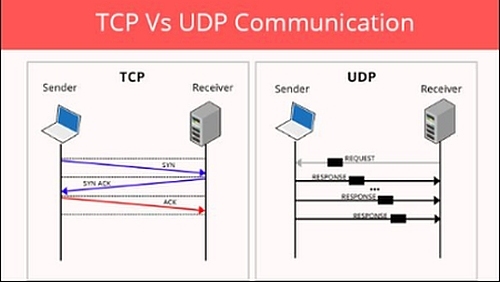
Up stream: Different Internet protocols stream data in different ways — and understanding the difference is essential to smooth sailing. (Source: Cyberhoot)
If a video frame from half a second ago gets lost, it may be better to move on than recover it too late. That is why UDP is commonly used for videoconferencing, Internet phone calls, online gaming and other interactive applications where low latency matters more than perfection.
Codecs do another critical job: They compress audio and video so they can travel over ordinary Internet connections. Without compression, modern streaming would overwhelm many home networks.
As codecs and network speeds have improved, video has moved from standard definition to high definition and now 4K. Content delivery networks also help, by placing copies of content on servers closer to viewers, reducing congestion and improving reliability.
Streaming is no longer just for movies, music or meetings. Astoria-based Steinway & Sons’ Spiriocast shows how far the idea can go. It lets one Spirio piano broadcast high-resolution performance data – including hammer and pedal movements – to other Spirio pianos (along with video), so the receiving instruments recreate the acoustic performance in real time.
In that case, streaming is not just sending sound to a speaker. It’s transmitting the performance itself, which is either a technical triumph or the most sophisticated ghost story ever.
At Hauppauge-based Intelligent Product Solutions, we’re proud of our partnership with Steinway & Sons and the work we have done to bring Spirio to life.

Is it live, or is it Spiriocast?: Only your pianist knows for sure.
The same concept becomes far more serious in healthcare. PriusMED’s medCLOUD technology applies real-time streaming to emergency responses, mobile integrated health, rural healthcare and hospital-at-home care by combining patient vitals, audio and video in a live clinical collaboration environment. Illinois-based PriusMED describes it as a “virtual emergency room.”
Long Island Streaming, a Plainview-based video-production and live-streaming company, shows how streaming has also become part of civic life. Town halls, graduation ceremonies, conferences, religious services, weddings, press events, sports and other public events no longer require everyone to be in the same room to participate.
At its core, streaming is the Internet learning to keep time. Sometimes it must keep perfect time, but more often it must simply keep good enough time for us to forget the engineering and enjoy the song – or the meeting, or the class, or the remote doctor, or the piano that appears to be playing itself.
Brad Carlson is vice president of technology and business development at Hauppauge-based Intelligent Product Solutions.