
By TERRY LYNAM //
Comparison shopping has never been easier – whether you’re buying a car, a home or pair of shoes, online searches retrieve price information in seconds, enabling consumers to make educated buying decisions.
 Figuring out the cost of medical care is a whole other story.
Not surprisingly, healthcare providers’ opaque billing practices are baffling to patients, few of whom can wrap their heads around the complexities of how services are priced, negotiated, paid for and regulated.
That’s a problem, considering the growing number of uninsured Americans and those with high-deductible health plans who could conceivably be shopping around for lower-cost care – but rarely do, despite the fact that 26.7 million Americans were without health insurance in 2024, nearly 5 million more are expected to lose coverage this year (due to the expiration of Affordable Care Act subsidies) and tens of millions of others with high-deductible plans are incurring exorbitant out-of-pocket expenses.
In response to these factors, hospitals nationwide have been under growing scrutiny over the past decade regarding their lack of price transparency. Earlier this month, the Trump administration ratcheted up the pressure, sending letters to 500 hospitals – including St. Francis Hospital in Roslyn and St. Catherine of Siena Hospital in Port Jefferson – warning that they could face penalties of up to $2 million annually for not fully complying with a 2019 executive order Trump signed during his first term, requiring hospitals to start disclosing their prices for common tests and procedures.

Terry Lynam: Seeing right through it.
The regulations require hospitals, as of 2021, to post all standard prices online in a single comprehensive file and provide consumer-friendly estimates for out-of-pocket costs for at least 300 common services. The administration contends that providing pricing information upfront helps drive down healthcare costs by giving patients practical information they can use to find the most affordable care, whether it be for blood work, imaging, surgery or other medical treatments.
While acknowledging that hospitals are committed to improving price transparency, the American Hospital Association contends the Trump-ordered framework “is not delivering actionable information for patients or useful insights for purchasers and policymakers.” Hospitals maintain that the standard charges they are required to post on their websites are not synonymous with the prices charged to patients for their unique episodes of care, which vary based on their health plan, the severity of a patient’s condition and the resources used by hospitals to deliver care.
The prices posted online also do not reflect what providers are actually paid by insurers, who often deny reimbursements or find other contractual loopholes to delay or avoid payment.
The medical coding that providers use to document the care they provide and seek reimbursement is part of a very complicated billing and payment process understood by few.
A good analogy to estimating healthcare prices is what happens when you bring your vehicle to a mechanic: Your “check engine” light is on, you’re probably clueless what the problem is and you won’t know for sure until the mechanic checks the computer sensors. While most people experiencing a medical issue can identify their symptoms, they won’t get a diagnosis until the doctor exams them and/or orders some tests.

Pain points: Medical services cost money — and the more services you require, the more you’re going to pay.
Like it or not, performing bloodwork or diagnostic tests like an X-ray or MRI add to the cost of care, so depending on what kind of insurance plan people have and their deductible, they may end up paying out-of-pocket for some services not covered by their health plan.
Depending on the diagnosis, they may also be referred to a specialist, who might recommend prescription drug treatment or more serious interventions like surgery or hospitalization. If that happens, you and your health plan will likely incur additional costs – just as you would if your vehicle needs a new transmission or some other major repair you weren’t expecting.
The bottom line is that the current federal policy on medical price transparency is not incentivizing patients to shop around or doing much to lower healthcare costs, according to researchers and industry insiders. A 2024 study by the National Bureau of Economic Research that examined New York outpatient services concluded that price transparency efforts had “minimal effect on consumer shopping.”
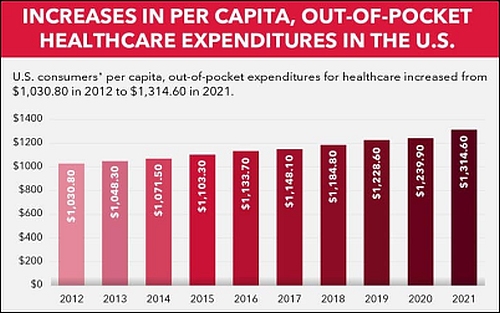
Pain in the pocket: Out-of-pocket costs for U.S. patients have been on a steady rise over the last decade. (Source: Peterson-KFF Health Tracker System)
Instead of helping consumers find cheaper care, analysts say the policy’s main benefit is that it establishes a framework for contract negotiations between insurers and healthcare providers, because they now know how much their competitors are getting paid for their various services – information previously considered confidential and proprietary.
Achieving medical price transparency is certainly a worthy objective. But the industry, policymakers and regulators have a lot of work ahead in aligning a solution that makes sense for consumers.
Terry Lynam is a communications consultant and former senior vice president/chief public relations officer for Northwell Health.