By DAVID PENNETTA //
Melville has a great business history – but action is needed now to keep the hamlet vibrant and relevant.
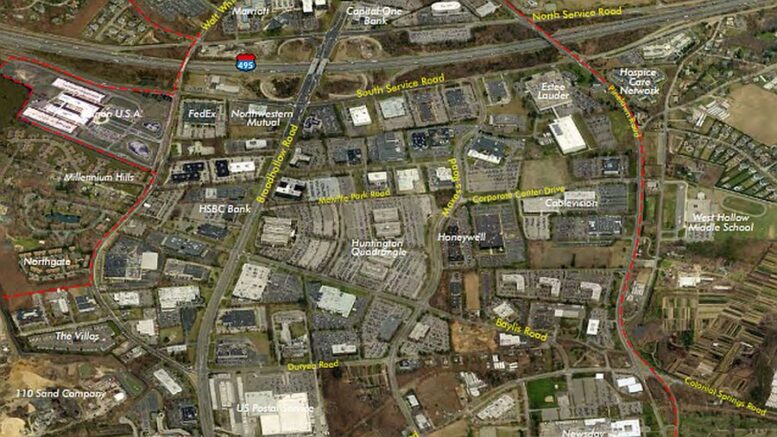
 The combination of office and warehousing spaces, bordered by single-family residential neighborhoods, has historically worked. Grumman (now Northrop Grumman), National Westminster Bank, Henry Schein and Estée Lauder are just a few of the major corporations that have called Melville home.
But that was back in the day, when Long Island was an inexpensive suburb, with the added distinction of the “first U.S. suburb,” Levittown, having risen nearby just two a few years earlier.
Today, thanks to “brain drain” and other factors, only Estée Lauder and Henry Schein are still in Melville – and the latter gave up 180,000 square feet of space in 2022.
Government officials have addressed the changing landscape through the years. Back in 2008, the Town of Huntington crafted the Horizons 2020 Master Plan, which among other things recommended a subsequent study focused specifically on Melville.

David Pennetta: Once and future Melville.
In 2013, the town launched the Melville Employment Center Plan, which looked at land use, zoning, traffic, infrastructure and other important issues in the hamlet. I was the chairman of this effort, which was funded by $200,000 from Huntington and local stakeholders and involved contributions from town planners and outside consultants.
The almost 300-page Melville Employment Center Plan espoused the potential addition of multi-use development and market-rate apartments. It was filled with appropriate recommendations and proposed actions.
But in 2020, COVID hit the world and everything changed. The work-from-home model was thrusted upon us, and it stuck – most office buildings have not recovered, with vacancies increasing steadily since 2020.
Meanwhile, speculation about a U.S. recession is weighing heavily. Some insiders believe vacant buildings will eventually seek real estate tax breaks and reassessments, which will hurt local municipalities and school districts relying on tax-driven income – and all those major vacancies will quickly drive down rents, further depressing the real estate market.
Governments are not helpless. For instance, allowing antiquated and underperforming office buildings to convert to mixed uses will reduce the regional office supply, making what remains healthier and more resilient.
And creating New York’s first Employment Oriented District – mimicking a Transit Oriented District, without the immediate rail access – also fits the bill. Consider Gov. Kathy Hochul’s recent attempts to compel expansion of Accessory Dwelling Units across the state, to the tune of 800,000 new housing units over the next decade – this necessitates a local Long Island response.

Have your say: Public interaction was a big part of the Melville Employment Center Plan.
The Huntington Town Board is currently considering actions that will enable these visions to move forward. Several municipal agencies are working together to bring about some much-needed change, trying to eradicate ancient mindsets that separate land by uses – residential here, industrial here, retail over there – and encourage development based more on logic and demand.
Hopefully, this will progress with some expediency – and enough flexibility to encourage creativeness and private investment. It’s the best path to return Melville to its former grandeur.
David Pennetta is executive managing director of Cushman & Wakefield’s Long Island office and co-president of the Commercial Industrial Brokers Society of Long Island.