By MICHAEL H. SAHN //
As expected, the United States Supreme Court’s momentous term rocked the nation and even shook the world.
 When the first African American woman to become an associate justice on the nation’s highest court isn’t the biggest news – not even close – you know the court’s been especially busy.
Federal Judge Ketanji Brown, a circuit judge on the U.S. Court of Appeals’ District of Columbia Circuit, achieved that historic first June 30, succeeding longtime Associate Justice Stephen Breyer, who retired at the end of a most tumultuous term.
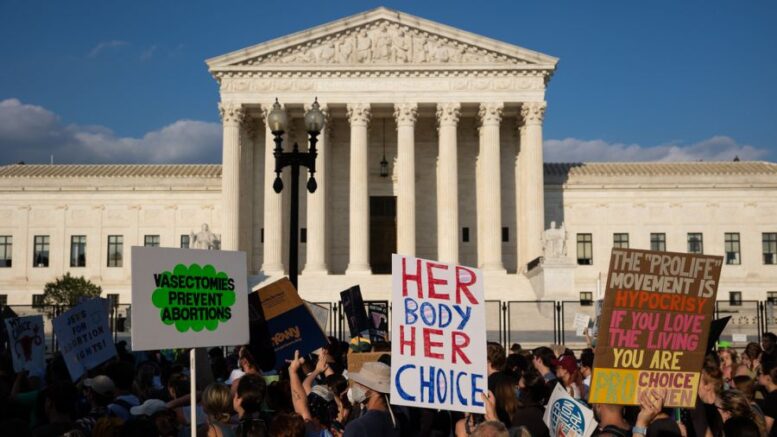
Topping the tumult, of course, was Dobbs v. Jackson Women’s Health, a decision that will certainly live in infamy. Although “leaked” prior to the court’s official vote – Chief Justice John Roberts is investigating – emotional supporters on both sides of the abortion issue really dug in on June 24, when the court actually issued its controversial 6-3 decision.
Speaking purely legally, reversing the almost 50-year holding of Roe v. Wade makes judicial precedent seem rather meaningless. The Supreme Court did a complete about-face here, essentially finding that Roe was wrong in the first place.

Michael Sahn: SCOTUS is just getting started.
This is understandingly frightening up and down the social spectrum. Associate Justice Clarence Thomas has already hinted – in his concurring Dobbs opinion – that the court just might do away with other past rulings protecting things like same-sex marriage and access to contraception.
The New York State Legislature, meanwhile, moved quickly to protect contraception and abortion access by passing the Equal Rights Amendment – essentially, the first step toward codifying the right to an abortion in the State Constitution. With a wary eye on future SCOTUS decisions, the amendment also prohibits discrimination based on sexual orientation and preference.
With a gubernatorial election this fall, expect abortion rights to be a major point of contention between Gov. Kathy Hochul and U.S. Rep. Lee Zeldin (R-NY 1), her Republican challenger. Meanwhile, New York will certainly become a destination for women from other states seeking legal abortions – pretty much what happened when abortion first became legal in the state in 1970.
The court also found that New York’s century-old gun licensing law violated the Second Amendment – essentially, concealed-carry permit applicants in New York no longer need to prove a specific need.
In response, the state legislature quickly enacted new handgun laws, requiring new training and limiting the “sensitive areas” – Times Square, for instance – where guns can be legally concealed. The new also law lets private property and business owners, including the owners of bars and restaurants, decide whether to allow people to carry guns on their premises.
Enforcement would seem difficult here, and it all sounds like an invitation to litigation. You can expect some of the coming lawsuits to spring from Long Island, where many support the SCOTUS concealed-carry decision and actively advocate for fewer gun restrictions.

Packing: You no longer need a specific reason to carry a concealed weapon in New York State.
By ideologically defeating the State of Maine’s nonsectarian requirement for tuition-assistance vouchers – essentially forcing Maine to fund private religious education – the court’s conservative supermajority also decided that separation of church and state, essentially our nation’s founding principle, is somehow unconstitutional.
And then there’s the court’s ruling in West Virginia v. EPA, which dramatically limited the U.S. Environmental Protection Agency’s ability to restrict greenhouse-gas emissions from power plants – and may actually be the most significant SCOTUS decision this term for New York and Long Island.
The 6-3 environmental hit job puts the burden of enacting and enforcing environmental protections squarely on state and local governments. On paper, that sounds fine – New York is ahead of this curve and Long Island is becoming an offshore-wind resource.
But climate change isn’t a local issue. Emissions don’t stop at state lines. For New York, where even smoke from distant western wildfires sometimes blots out the sun, this likely means increased carbon emissions emanating from other states.
These momentous decisions beg the question: What’s next? The answer, unfortunately, is plenty.
Even with Brown on the bench, the new court still features that same supermajority. And there are more big cases coming, including challenges to Affirmative Action in public- and private-university admissions (potentially, another reversal of decades of precedent) and an Alabama case regarding election-district lines (potentially moving a majority of minorities into a single district).
There’s also a last-minute addition to the coming docket that will decide if state legislatures, instead of state courts, can oversee voting in federal elections – a potential game-changer that not only affects the next presidential election, but foreshadows more contention about our entire electoral process.
With the U.S. Congress unable to compromise on core issues, the midterms upon us and a heated presidential campaign approaching, the slanted SCOTUS will remain busy – and will continue on as a controversial lightening rod for public debate.
Michael H. Sahn, Esq., is the managing member of Uniondale law firm Sahn Ward Braff Koblenz PLLC, where he concentrates on zoning and land-use planning, real estate law and transactions, and corporate, municipal and environmental law. He also represents the firm’s clients in civil litigation and appeals.