
By GREGORY ZELLER //
Have you burnt a fortnight on Fortnite? Lost count of your Counter-Strike hours? Are you legendary for your marathon League of Legends sessions?
 Congratulations – you’re at major risk for developing blood clots, which can figuratively and literally mean “game over.”
Venous thromboembolisms, known best as blood clots, are serious health risks. According to the U.S. Centers for Disease Control and Prevention, clots strike roughly 900,000 Americans annually, and prove fatal for about 100,000.
With deep vein thromboses – blood clots that form in one or more of the body’s deep veins, typically in the legs – on the rise among competitive e-gamers (who typically play between three and 10 hours daily), researchers at the New York Institute of Technology’s Center for Esports Medicine have explored various countermeasures, including short walking breaks and compression sleeves worn below the knees.
“As collegiate eSports continue to grow, we’ve seen that coaches are desperate for information on how to make their players healthier,” noted New York Institute of Technology College of Osteopathic Medicine Professor and Clinical Research Director Joanne Donoghue.

Joanne Donoghue: Don’t just sit there.
With that in mind, the New York Tech researchers – working with experts from London-based eSports organization Fnatics – are endeavoring to learn more about the physiological effects of long, largely sedentary gaming sessions, and the best ways to counteract them.
In 2023, the partners conducted a study examining the use of compression garments around the elbows, concluding that the sleeves reduced fatigue, improved muscle recovery and even heightened in-game performances.
Their latest leg-based findings, published last month in the peer-reviewed American Journal of Physiology-Heart and Circulatory Physiology, suggest moderate benefits from the use of lower-leg compression sleeves – and much larger returns from putting down the controllers and taking a short walk.
This time around, researchers analyzed 10 healthy, college-aged gamers – all ranked eSports players with 500-plus hours of playing time under the virtual belts – over the course of three visits.
During one visit, players engaged in two hours of uninterrupted gameplay with no interventions. In another, players took a six-minute walk at a comfortable pace halfway through their two-hour session. During the third visit, they wore a fitted compression sleeve below the knee while playing continuously for two hours.
Each time, researchers used Doppler ultrasound technology to measure the players’ left popliteal artery, a primary vessel that delivers blood to the knee and lower leg and is prone to blood clots. Data was collected at 30-, 60-, 90- and 120-minute intervals on blood-vessel diameter, blood-flow velocity and blood-flow volume.
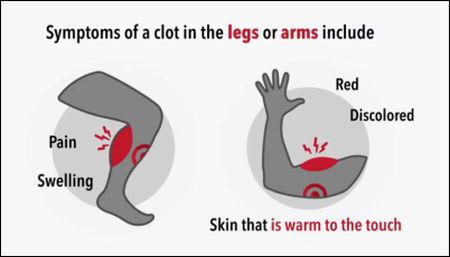
Clots to worry about: Blood clots kill tens of thousands of Americans every year. (Source: U.S. Centers for Disease Control and Prevention)
According to the data, blood flow and blood velocity both dropped precipitously during the session with no interventions, with blood-flow volume decreasing by 46 percent after two hours.
The compression sleeves offered modest benefits, with blood flow still decreasing by 31 percent after two hours, while the six-minute walking breaks proved most beneficial, with players experiencing a 20-percent blood-flow decrease at the two-hour mark.
Players were also quizzed about the effects of the walks and sleeves on their gameplay. Only 11 percent of surveyed players said they felt the lower-leg compression sleeves had a positive effect – while 67 percent said they believed the walking break had positive effects.
Researchers hope the new data, combined with the results of last year’s study, will help establish the first health guidelines for collegiate eSports athletes – and even casual gamers who may spend several immobile hours per day enjoying their favorite digital diversion.
“Because eSports [are] not yet [National Collegiate Athletics Association]-regulated, there are no available health regulations like those that exist for traditional sports, such as football,” Donoghue said. “Hopefully, our research will inspire additional studies and conversations that eventually lead to these much-needed rules at the college level.”