By GREGORY ZELLER //
If you liked Gov. Kathy Hochul’s 2022 State of the State Address, you’ll likely love her roughly $200 billion Fiscal Year 2023 Executive Budget.
 But don’t be fooled by that weighty price tag: The FY2023 spending plan, part of an Executive Budget Financial Plan that provides for balanced state operations through FY2027, grows state operational funding by only 3.1 percent in FY 2023 – below the projected national inflation rate of 3.2 percent.
And despite growing total expenditures by only 2 percent over the FY2022 Executive Budget, the plan includes a full slate of hefty taxpayer-friendly investments: $2 billion for property tax relief, $2.3 billion for pandemic-recovery initiatives (including $350 million for small-business and theater/musical arts assistance) and much more.
With billions for Department of Transportation capital projects, next-generation energy investments and a “healthcare transformation” – more than $1 billion in bonuses for frontline healthcare workers – the FY2023 Executive Budget certainly puts its money where its mouth is. Hochul called it a “once-in-a-generation opportunity for the future with a historic level of funding that is both socially responsible and fiscally prudent.”
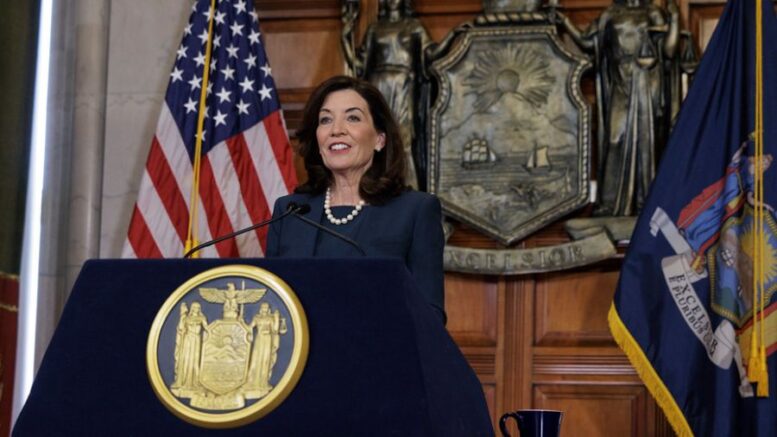
It’s also a “once-in-a-generation opportunity,” according to the governor, who referenced many of the ambitious expenditures in her State of the State address earlier this month and insisted again Tuesday that New York has “the means to immediately respond to the COVID-19 pandemic.”

Robert Mujica Jr.: You deserve it.
“It’s time for a better, fairer and more inclusive version of the American Dream,” Hochul said, echoing her Jan. 5 rallying cry. “I’m calling it the New York Dream.
“We will make that New York Dream real,” she added, “and ensure that it can be realized by every single New Yorker.”
Projecting a healthy rebound in statewide tax revenues, the governor’s office noted that even with $200 billion-plus in projected FY2023 spending – and an FY2023 Executive Budget that holds spending growth below the expected increase in the national inflation rate – New York’s books are balanced through 2027, with “no budget gaps.”
Among other FY2023 Executive Budget highlights: $31.3 billion in total school aid, the highest level of state aid ever offered; Phase One of a five-year, $1.5 billion investment in State University of New York and City University of New York operations; and the start of a five-year, $32.8 billion DOT capital plan, with Suffolk County’s troublesome Oakdale Merge among several large-scale improvement projects on the board.
The FY2023 budget plan also accelerates implementation of a middle-class tax cut that’s been phasing in since 2018, with new relief targeting 6.1 million New York taxpayers; creates a new small-business tax credit for COVID-related expenses; provides small-business and homeowner tax rebates; kicks off a five-year, $25 billion “comprehensive housing plan”; and includes hundreds of millions in new investments to support the childcare industry.
State legislators will now modify and enact the governor’s budget proposal into law. The new fiscal year is set to begin April 1.
State Budget Director Robert Mujica Jr. doesn’t anticipate too many changes to the proposed spending plan, which he called “the budget that New Yorkers deserve and expect.”
“Never again will the state find itself unprepared for the opportunities or challenges ahead,” Mujica added. “After years of unprecedented hardship, this budget makes the state, from a financial perspective, as resilient as its spirit.”