By GREGORY ZELLER //
The species that brought you Mini-Me, the MINI Cooper and M&M’s Minis now gives a poop with the “mini colon.”
 Behold, the world’s first functional, drug-testable, 3D-printed human colon model, squeezed out by a team of researchers including bioengineer Steven Zanganeh, an assistant professor in the New York Institute of Technology’s College of Engineering and Computing Sciences.
As detailed in September in the open-access multidisciplinary journal Advanced Science, Zanganeh and colleagues at the University of California-Irvine (where the model was printed) used cancer cells from a tumor biopsy to grow a personalized “mini colon” that closely mimicked human tissue – close enough to help determine which oncological drugs might work best for the source patient.
With colorectal cancer looming as United States’ third-most common cancer diagnosis and third-leading cause of cancer-related deaths – and with 154,000 new U.S. cases diagnosed annually – the researchers are not close to replacing sick colons with cured clones.

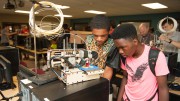
Steven Zanganeh: Model behavior.
But their groundbreaking research does point toward safer, faster and more effective colon-cancer treatments – and an entirely new platform for broader disease research beyond the colon, according to Zanganeh, who trumpeted “a true leap forward in biomedical innovation.”
“This is, to our knowledge, the first model of its kind,” the bioengineer noted. “While this project successfully replicated a human colon, it also opens doors to create functional tissue for virtually any human organ.”
Starting with CT scan data, the researchers mapped out the target colon’s anatomy in fine detail, then packed an advanced 3D printer with hydrogels – synthetic polymer chains that can absorb and retain relatively large amounts of water, used often in tissue engineering – and fabricated a model mimicking the source colon’s specific shape and functionality.
The model, which was actually printed at UC Irvine, was also given a tumor, which the researchers were able to treat successfully.
Rahim Esfandyar-Pour – the assistant professor of electrical engineering and computer science in UC Irvine’s Department of Biomedical Engineering who designed the study, analyzed the data and wrote the first draft of the Advanced Science paper – said the results suggested a new and powerful platform for cancer-drug discovery and disease modeling.
“Our 3D, human-relevant colon model overcomes key limitations of 2D cell cultures and animal studies,” Esfandyar-Pour said in a statement. “It lets us study disease and drug responses in a way that is far closer to the patient, opening a faster, more reliable path to new therapies.”

How to clone a colon: How researchers at New York Tech and UC Irvine created the “mini colon,” tumor and all. (Source: The New York Institute of Technology)
Zanganeh and his research team, which includes doctoral and graduate students from New York Tech’s College of Engineering and Computing Sciences and College of Osteopathic Medicine, are now planning to develop additional 3D tissue models, including prototypes that can handle electrical stimulation and replicate immune functions.
The scientist, who ultimately plans to commercialize the tissue-modeling technology, foresees entirely new directions for laboratory and clinical research – all stemming from the debut “mini colon.”
“This breakthrough points to a future in which therapeutic testing can be performed without dependence on traditional cell cultures or animal models, streamlining the path to clinical trials,” Zanganeh added. “What once sounded like science fiction is now reality.”