By GREGORY ZELLER //
A popular writer with a penchant for poetry, an itch for education and close ties to a top Long Island university is storming shelves again.
 Kentucky-raised, New York City-based author, performer and educator Ellen Hagan, an adjunct professor at Garden City-based Adelphi University, is set to release her third young-adult novel July 19, published by stalwart British house Bloomsbury Publishing.
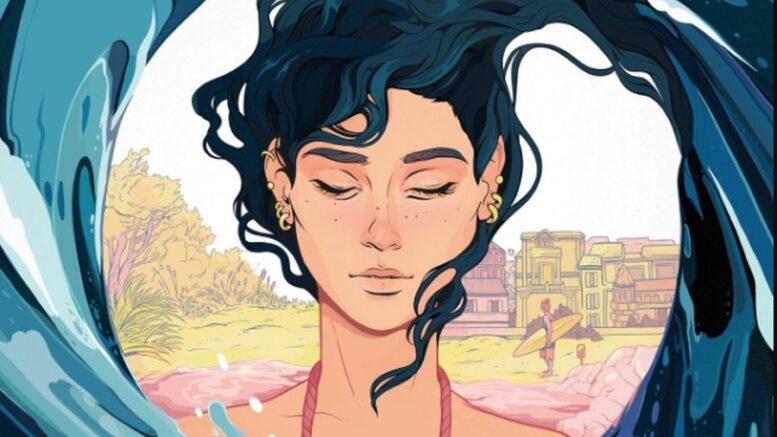
“Don’t Call Me a Hurricane” is a coming-of-age story set on the Jersey Shore, with several genre-familiar trappings: a passionate, self-reliant local with likeminded friends, PTSD and a noble cause, not to mention senior year to worry about; a cute rich boy who doesn’t know anything about said cause, though it’s kinda hard to hate him; a positive overall message about learning to love those who see the world differently, certainly welcome in these troubled times.
But if the setup is typical, the execution is anything but: Hagan’s brainy book, which also leverages big-picture messages about global warming and changing ocean tides, is told in verse – eschewing customary prose for some novel-length narrative poetry.

Ellen Hagan: Teaching by storm.
It sounds like an immense challenge, and it is. But verse is form and function for Hagan, a 2020 New York Foundation for the Arts poetry fellow whose now six-book collection includes the identity-deconstructing poesy collection “Blooming Fiascoes,” and whose work has graced ESPN The Magazine and several anthologies, including the women’s-poetry collection “She Walks in Beauty” and “Southern Sin,” a steamy “creative nonfiction” compilation.
Consider how Hagan introduces Eliza Marino, young hero of “Don’t Call Me a Hurricane,” a character you surely know from other YA novels, or from parenting teens, or from having been one yourself.
Eliza and her save-the-world message check off boxes common to teen romances and Hallmark Christmas movies: Five years after losing her home to a hurricane, she’s determined to save Clam Cove Reserve, a chunk of pristine wetlands slated for development.
To her credit, Hagan – who has co-led Adelphi’s Alice Hoffman Young Writers Retreat for high school students – takes full advantage of a teaching moment by giving Eliza a real-world cause relevant to our times.
But that’s just the start of the creative journey for this standout scribe, who lets Eliza herself do the introductions:
My father used to call me a hurricane
Wild & unruly
Rowdy & messy
Fast & reckless
Unmoving & impulsive
Headstrong & willful
Unexpected & quick
Electric & fleeting
Floating & flying
Scrappy & breakneck
All the time moving & flowing & buried & flashing & free
Free, free
Now –
We are careful not to compare anything to a hurricane
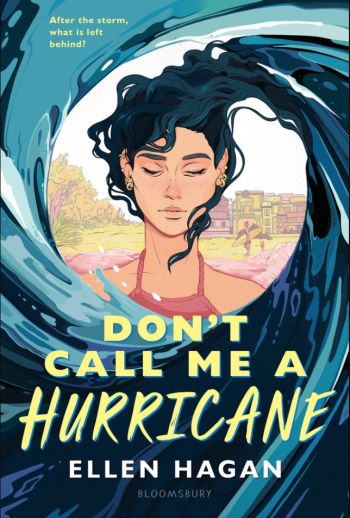
Cover story: Your typical teenage climate-activist love story, told in verse.
The story unfolds in ways we know – Eliza has familiar friends with recognizable motivations, star-crossed love blooms with the cute rich boy, who of course hides a pivotal secret – and in ways we don’t, thanks to its poetic flow.
While carving a unique level of linguistic excellence and creating an appealing plot for the lucrative 12-to-18-year-old target audience (and its short attention span), “Don’t Call Me a Hurricane” is, at heart, a deep dive into climate change and climate justice.
“The more I followed what’s happening in this global crisis, the more I thought, ‘How does art respond to some of these issues?’” noted Hagan, a 20-year veteran educator. “‘How do young people speak back to what’s happening?’
“‘How do you create and begin to be in dialogue with some of these larger social-justice issues?’” Hagan added. “That’s really what inspired the book.”
While the issues are serious and the form – particularly in the YA genre – stands out, writing the book was a total blast, according to its creator, who hopes readers will share the thrill.
“I had so much fun writing this book,” Hagan said. “This one feels like the biggest love story that I’ve written.”