

By BRAD CARLSON //
When it comes to 3D imaging technologies, there are two main applications: volumetric imaging and surface imaging.
 Think of volumetric imaging as the seasoned veteran – technologies like X-ray computed tomography, ultrasound and magnetic resonance imaging have been making their mark on healthcare for decades. They are the reliable workhorses of the medical world, giving us detailed internal views of the human body.
On the other hand, 3D surface imaging is the scrappy up-and-comer with relevance to a broader set of markets. While it’s been in development for decades, it’s only recently flexed its muscles in industries like healthcare, automotive, manufacturing and beyond.
A 3D surface imaging system combines good old-fashioned 2D photogrammetry with a way to measure the distance to a target, allowing it to reconstruct a 3D image of an object or scene. The method for measuring that distance depends on the application, and there are some very cool applications.
Take modern cars, for example. They use light detection and ranging for lane tracking and collision avoidance. One of the most popular features? Automated cruise control, which measures the distance to the car in front and adjusts your speed to maintain a safe gap.

Brad Carlson: Another dimension.
On the open highway, it’s a dream. On Long Island’s congested roadways? Let’s just say it’s less of a dream and more of a “why is my car braking again?” moment.
Essentially, LiDAR is a type of time-of-flight measurement that uses pulsed lasers. Time-of-flight imaging isn’t just for cars. It’s also found in robotics and even in your pocket: Some Apple and Android phones now come equipped with ToF 3D imaging systems, proving this tech is as versatile as it is impressive.
Another method, developed by Zebra Technologies (now headquartered in Illinois, still thriving in Holtsville), uses structured light projection, wherein a uniform light pattern is projected onto an object and the object’s surface distorts the pattern. By analyzing the distortion, the system reconstructs the object’s surface in three dimensions.
My company, Intelligent Product Solutions, once teamed up with Zebra to create a dimensioning system for the packing of shipping trucks and warehouses. It was like playing a life-size game of Tetris, optimizing space for packages.
Today, Zebra has taken this tech to the next level, offering parcel dimensioning integrated into rugged mobile devices.
But wait, there’s more! Surface dimensioning has also made its way into the dental world.
For decades, dentists have used impression materials to capture the surfaces of teeth. This involves filling a tray with putty, pressing it against your teeth and creating a “negative replica.”
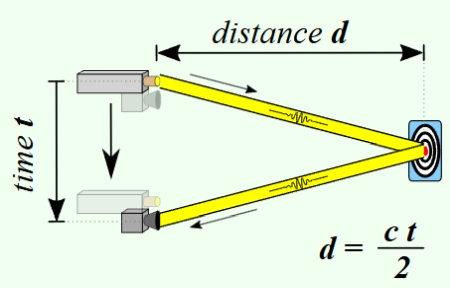
Flight pattern: Complex time-of-flight technology is found in many everyday devices.
While modern molding materials are fast-setting and stable, the physical model has its limitations. Enter digitization: By scanning the impression or model, or using an intraoral scanner to directly capture a digital model in the mouth, dentists can now fabricate crowns, aligners and other prosthetics using milling or 3D-printing tech.
Intraoral scanning is where things get interesting. First introduced by Dentsply-Sirona, these scanners were part of a CAD/CAM solution that allowed dentists to complete restorative procedures in a single office visit. Early scanners required a powder coating on the teeth to counteract the effects of saliva on the optical system – not exactly ideal, but it was a good start.
Fast forward to today. Modern intraoral scanners have ditched the powder, thanks to confocal imaging. Adapted from confocal microscopy, this technique uses two key optical concepts: focus distance and depth of field.
Confocal imaging systems have a very narrow depth of field, meaning they only capture objects in focus at a specific distance. By rapidly adjusting the focus distance, the scanner captures a series of in-focus images or slices (called point clouds) as it moves across the teeth. These point clouds are then stitched together by software to create a detailed 3D surface model.
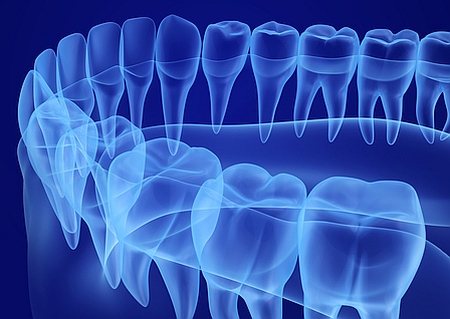
Bite bytes: Digital 3D modeling has become a mainstay of dental sciences.
Intraoral scanning has become a gamechanger in dentistry. Digital impressions are one of the fastest-growing product segments in the market, and companies like Melville-based Henry Schein Dental are leading the charge. These scanners are used for everything from restorative dentistry to orthodontics, and who knows? One day, they might even be used to track the health of our teeth and jaws over time, creating a digital record of how we age.
So, the next time your dentist reaches for that tray of putty, do yourself a favor and ask about intraoral scanning. Not only will you avoid the gag-inducing experience of having a tray shoved to the back of your throat, but you’ll also be embracing the future of dental care.
And let’s be honest – who doesn’t want to feel like they’re living in a sci-fi movie while sitting in the dentist’s chair?
Brad Carlson is vice president of technology and business development at Hauppauge-based Intelligent Product Solutions.





Be the first to comment on "Clarifying vision, from highways to the dentist’s office"