By TERRY LYNAM //
Most people don’t spend a lot of time thinking about the financial health of America’s hospitals, but if things don’t change fast, millions soon will.
 Still reeling from COVID impacts, thousands of hospitals – especially in the Northeast – are in severe financial distress, with two-thirds expected to report negative operating margins for 2022.
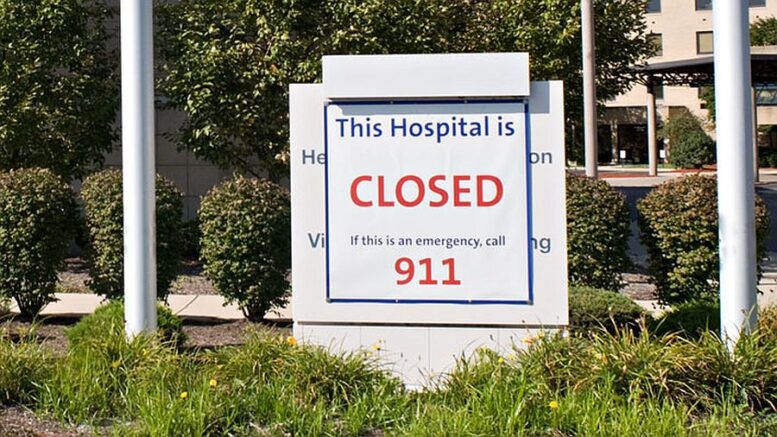
If this crisis continues, services will be cut, wait times will increase and more hospitals will be forced to close, or at least eliminate inpatient care. The outlook is particularly dire in rural and poorer urban communities, where higher percentages of patients on Medicaid and Medicare make it harder for hospitals to overcome deficits.
It’s a perfect storm of bad omens, right down the line.
Federal COVID relief funds exceeding $178 billion propped up many struggling hospitals and healthcare providers during the pandemic, but that money has largely dried up. Meanwhile, health systems both large and small are being staggered by unprecedented workforce shortages, particularly among nurses (the average RN vacancy rate hit 17 percent nationally in 2022, up from 8 percent pre-pandemic).

Terry Lynam: Red alert.
And unreliable supply chains, combined with soaring inflation, have increased healthcare costs across the board.
At some of the nation’s biggest health systems, like Providence Health & Services and CommonSpirit Health and “even Memorial Sloan-Kettering,” according to Northwell Health Executive Vice President Rich Miller, “their losses from operations are staggering – in the hundreds of millions and, in some cases, more than $1 billion.”
“So, it’s not just the ‘have-nots’ or the safety-net hospitals,” adds Miller, Northwell’s chief business strategy officer. “It’s also the ‘haves’ that are facing tremendous financial pressures.”
Here in New York, 64 percent of health systems and hospitals are expected to end 2022 in the red, according to a dire report issued in December by the Healthcare Association of New York State.
Unlike other consumers businesses, health systems and hospitals can’t simply increase their prices to make up for inflation-driven expenses. Most care is paid for based on prices set by the federal government via Medicare and Medicaid, which covered a record 156 million enrollees as of September 2022 – about 91 million on Medicaid and 65 million on Medicare.
The problem for hospitals is that they lose about 8.5 cents for every dollar they spend treating Medicare patients, and about 12 cents on the dollar treating Medicaid patients. And it’s mostly Medicare and Medicaid patients who wind up in hospital beds: 94 percent of all hospitals have half of their inpatient days paid by Medicare and Medicaid, according to the American Hospital Association, which says Medicare and Medicaid hospital underpayments totaled $100 billion in 2020.

Rich Miller: Pressure-packed.
To make up for the money they lose treating Medicare and Medicaid patients, healthcare providers rely heavily on higher reimbursement rates from commercial insurers like CVS/Aetna, UnitedHealthcare and Elevance Health (formerly Anthem). But the commercial payers are getting increasingly aggressive pushing back against provider rate increases, leaving little room for hospitals to cover escalating expenses.
And so, operating margins continue to plunge.
Larger health systems can weather the storm. The outlook is more worrisome for public hospitals like the Nassau University Medical Center and other safety-net hospitals. With federal COVID funds disappearing, the state now is solely on the hook for shouldering those rapidly growing deficits.
Based on her 2023 state budget proposal, Gov. Kathy Hochul appears ready to assume the additional burden. Hochul has proposed $3.9 billion in state funding to aid hospitals struggling financially from the pandemic and is calling for the creation of a Commission on the Future of Healthcare to identify and eliminate waste throughout the healthcare system and promote long-term stability in struggling hospitals.
Some suspect this new entity could end up pursuing some of the hospital-restructuring framework triggered in 2006 by the Commission on Healthcare Facilities in the 21st Century, Albany’s so-called “Berger Commission,” which led to the closure of nine statewide hospitals and major changes at 48 others.
As hospital inpatient numbers continue to decline – with more care delivered in outpatient facilities, physician offices and telehealth settings – it may become unsustainable to continue subsidizing full-service hospitals, especially those with mounting deficits and empty beds.
According to Miller, “The question will become: Can the state continue to bail out these hospitals that are losing $100 million to $200 million a year?”
“Some of these places are going to have to be redeployed into ambulatory facilities, perhaps with select inpatient services,” the strategy chief adds. “Over time, there’s going to have to be some rationalization.”
Terry Lynam is a communications consultant and former senior vice president/chief public relations officer for Northwell Health.