By GREGORY ZELLER //
They’re thinking outside the box at different points along the COVID-19 vaccine distribution lines, and that includes New York State – where the thinking is decidedly inside the box, actually, and “America’s doctor” approves.
 Behold, the COVID Cold Chain, the logistical blueprint of a temperature-controlled, time-sensitive national distribution network that’s anything but Point A-to-Point B. As Pfizer and Moderna begin distribution this month of their novel coronavirus vaccines – with other biopharmas right behind them, as 58 human trials and more than 80 other preclinical candidates plug along – authorities and organizations from coast to coast are collaborating on what some have labeled the biggest U.S. logistical operation since World War II.
The challenges are multifold, going way beyond sheer numbers – though the numbers themselves are daunting enough, with federal officials announcing plans to inoculate 20 million Americans this month alone, requiring the distribution of 40 million doses, and the lion’s share of Americans waiting after that.
On top of that, Moderna’s vaccine must be shipped and stored at a frigid negative 4 degrees Fahrenheit, while Pfizer’s vaccine requires even colder environs: negative 94 degrees Fahrenheit.
And both have limited shelf lives. Moderna’s vaccine can be stored at negative 4 degrees Fahrenheit for six months, but to be used it must be thawed in a refrigerator set around 40 degrees Fahrenheit – and it’s only good for 30 days at that relatively balmy temperature.
Pfizer’s deep-freeze vaccine, meanwhile, must be administered within five days of refrigerated thawing.

Unwrapped: The governor gets into the COVID-19 Cold Storage Box.
Future vaccines to emerge from the federal trial-and-approval gauntlet will bring similar restrictions – making new methods of transporting and storing millions and millions of tiny glass vials paramount.
One critical component of the COVID Cold Chain was spotlighted this week in Albany, where Gov. Andrew Cuomo displayed a COVID-19 Vaccine Cold Storage Box – a high-tech apparatus in a low-tech wrapper that comes loaded with thousands of vaccine doses, a built-in GPS tracker, a dry ice escort and a complicated set of rules requiring strict adherence.
The governor marveled at the Cold Storage Box, a large box packed with ice and a wired contraption about the size of first base or an extra-deep personal pizza box, outfitted with its own thermal monitor and, for demonstration purposes, carrying a supply of Pfizer vaccines – as many as 5,000 in a single package this size, according to Cuomo.
“It comes wrapped in dry ice … because it has to be ultra-cold,” he noted. “When you receive the package, you have to replace the dry ice, and then you have to replace the dry ice every five days.”
And that’s just the start of the byzantine operating procedures, which include those unbreakable cold-storage restrictions and stringent opening-and-closing rules – the smaller container, which actually holds the trays of tiny glass vials, can only be opened twice per day, for instance.
“The storage and handling of the box itself is complicated,” Cuomo understated.
The governor credited the Cold Storage Box to New York ingenuity, noting multinational Pfizer’s New York headquarters and glass vials crafted by Corning Inc., a multinational materials-science innovator based in upstate Steuben County.
“Pfizer developed the vaccine without any assistance from the federal government,” Cuomo said, parrying President Donald Trump’s attempts to claim credit for the breakthrough vaccine.
“They did it all on their own, and we’re very proud to call them a New York company,” the governor added. “The vials are made of glass from Corning, another great New York company.”

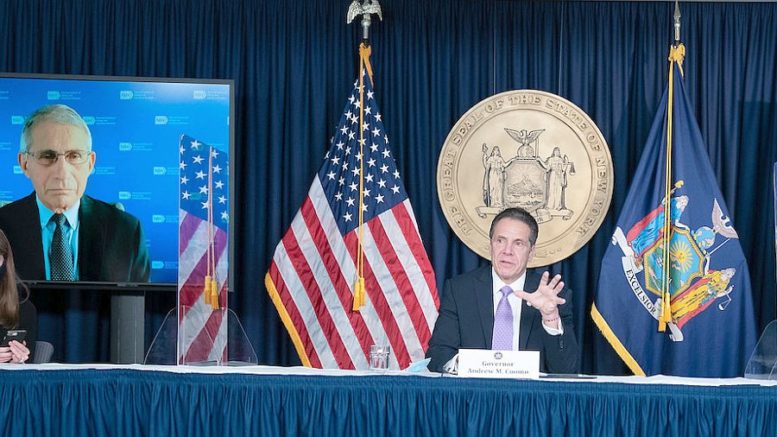
Anthony Fauci: New York is ready.
The complexity of the Cold Storage Boxes are a small price to pay to protect “the weapon that is going to win the war,” according to Cuomo, who’s dealing with complexities of another sort as New York rolls out its Winter COVID Plan.
The comprehensive game plan leverages five “targeted strategies” designed to mitigate COVID-19’s cold-weather spread: managing hospital capacity (thereby enhancing care), increasing (and balancing) testing resources, keeping schools open safely, preventing viral spread through smaller gatherings and effecting a safe, equitable vaccination program.
That’s a lot of important balls to juggle – but such is the Age of Coronavirus, according to Cuomo, who cheerfully reminded New Yorkers “we’ve been through the worst.”
“We must adapt to this reality and have a plan in place that specifically addresses the challenges that come with it,” the governor said. “While we’re not done yet, we are moving forward with the lessons we learned in the spring to come through this together.”
Certain facets of the Winter COVID Plan have already ruffled feathers. National debate rages about whether schools should be open at all for in-person learning, or should not; Cuomo’s previous attempts to enforce size restrictions on private gatherings and religious ceremonies have generated everything from defiant law enforcers to a U.S. Supreme Court rebuff.
But Cuomo has at least one high-profile champion in his corner: Anthony Fauci, 36-year director of the National Institute of Allergy and Infectious Diseases and the personification of the science of COVID-19.
The immunologist, who survived the Trump Presidency (so far) despite months at odds with the mercurial president over the severity of the novel coronavirus and recommended responses, applauded New York’s Winter COVID Plan during a virtual press event Monday, appearing with Cuomo to deliver his stamp of approval.
Fauci said the five-point plan “seems really sound” and is packed with “a lot of backup contingencies, which I like.”
The nation’s leading infectious diseases expert, a Brooklyn native and graduate of Manhattan’s Regis High School, said it was “painful” to watch Greater New York suffer through Round 1 of the virus – “You guys got really slammed” – but noted his old stomping grounds were in much better shape as the long-predicted second wave rolls through.
“You got hit with a sucker punch [last winter], when the cases came in from Europe and the Northeastern corridor – particularly New York State, particularly the metropolitan area – got hit really, really badly,” the doctor said. “And you rebounded in a way that you kept your test positivity low, because you did the prudent things that you need to do.
“You’re not going to get caught shorthanded [this winter], I’m certain,” Fauci added.