By MARILYNN ELIE //
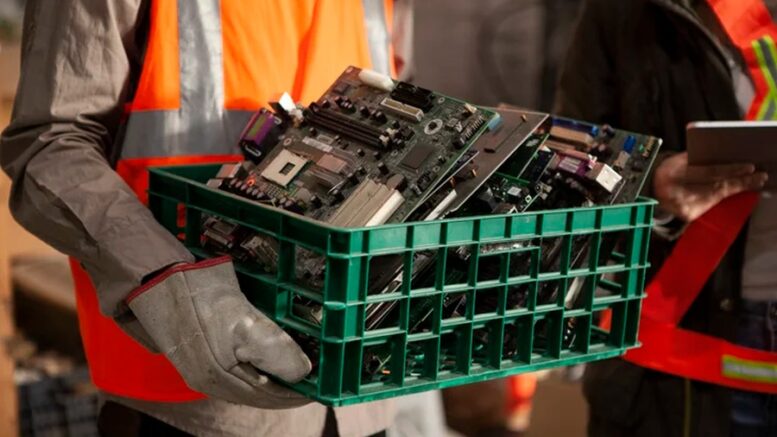
A Hauppauge-based tech startup determined to keep electronic waste out of landfills has crossed a major milestone.
 Pupfish Sustainability Solutions, founded in 2020 by partners David Faverio, Nancy Brokaw and Jackie DeMauro, has now processed more than 500,000 pounds of discarded electronics. And the pile is growing.
The company, which weighs and reports its processed poundage to the New York State Department of Environmental Conservation, handles roughly 200,000 pounds of electronic equipment annually – a big jump from the 30 total pounds it processed during its first three months, according to Faverio.
Already busy servicing 15 Long Island school districts (and their Summer rush of retired laptops and tablets), Pupfish recently added two significant medical clients, including one with 100-plus locations across Greater New York and another with a national footprint – making for an “extremely busy” phase for the company, Faverio noted.

David Faverio: Trash man.
Of course, recycling old equipment is only one part of the mission: Tossing an old computer, including devices that sometimes contain sensitive information, isn’t as simple as hitting “delete” and throwing it away.
Dumpsters may be “our biggest competitor,” according to the cofounder, but as a certified data-destruction company, Pupfish specializes in something simple trash receptacles can’t. And data destruction is not limited to devices like computers and cellphones, which users naturally associate with data storage: Printers, network switches and other electronics also retain loads of personal information.
Even a factory reset can leave behind residual data, Faverio said – larger printers and copiers, for example, may contain their own hard drives and stores of scanned and copied documents.
To make sure both hardware and data are handled properly, Pupfish follows a set-in-stone process that starts with tracking. The company collects equipment in GPS-tracked vehicles and transports it to its secure Hauppauge facility, where computers and removable hard drives are assigned separate identification numbers, allowing the team to track them throughout the disposal processes.
Depending on the equipment and its condition, data can be sanitized through specialized software, destroyed through cutting-edge degaussing techniques or eliminated through physical destruction. Pupfish always provides documentation showing what happened to the equipment and its data.
Those records matter. Pupfish is International Secure Information Governance & Management Association-certified, requiring documented procedures, intensive employee screening and recurring audits – with i-SIGMA auditors sometimes arriving unannounced, according to Faverio, to review company procedures and watch employees do their thing to ensure proper procedures are followed.
Sanitization protocols can overwrite existing information while preserving certain devices for post-cleansing reuse, sale or donation. Faverio estimates that roughly one-third of the equipment Pupfish handles can be repurposed, depending on the condition of what comes through the door.
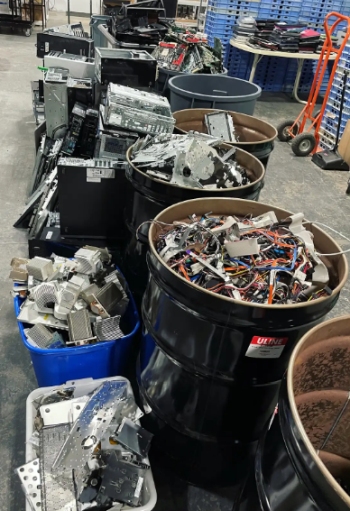
Bin there, done that: But trashcans full of old electronics equipment don’t have to wind up in regional landfills.
The company regularly donates reusable equipment to nonprofit organizations. But when a device isn’t reusable, the process is very different.
For traditional magnetic hard drives, Pupfish wields a state-of-the-art degausser that demagnetizes the platter containing the information and permanently renders the drive unusable. Faverio and his team recently put that high-speed capacity to work on a school-district project involving more than 6,000 drives and 2,000 tapes, completing the entire job in less than two days.
“We don’t believe in leaving any data behind,” he noted.
Data destruction wasn’t exactly the career Faverio imagined for himself. His career began in commercial lending at Citibank, before he eventually became CFO of MITEQ Inc. (now Narda-MITEQ), his father’s Hauppauge-based satellite-communications manufacturing company, which grew to more than 700 employees.
Later, while considering his next career move, Faverio and some longtime colleagues started talking about creating something of their own; a mutual interest in preserving the natural environment opened their eyes to opportunities in electronics recycling and the critical need for quality data destruction.
Faverio credits much of what followed to the people around him, whom he describes as detail-oriented, reliable and willing to do whatever’s necessary to get the job done.
“I trust them implicitly,” he said of Brokaw, Pupfish’s VP and operations director, and DeMauro, the company’s accounting manager.
Pupfish’s 5,000-square-foot Hauppauge facility has also evolved through the years. Faverio remembers having enough empty space for the team to spread out and even squeeze in a few rounds of indoor cornhole; today, pallets, equipment and workstations fill the converted warehouse, with more equipment arriving regularly.
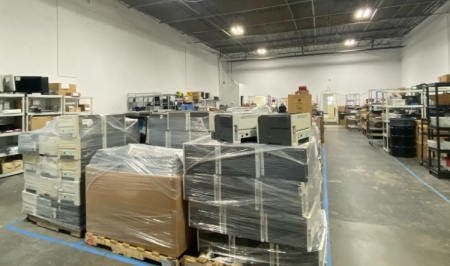
Make a (corn)hole: A warehouse that once seemed oversized no longer has room for fun and games.
“I’m starting to worry we may be running out of space,” the co-founder said.
Rather than immediately jumping into a larger space, however, the team has prioritized efficiency in its operations and layout – a very different problem for a company that once had extra cornhole space.
Business doesn’t figure to slow down anytime soon. Pupfish works with the Longwood Public Library and the Riverhead Free Library on community collection events, giving residents free data-destruction opportunities, and also partners on an internship pipeline with Hempstead-based nonprofit Morrison Mentors, which trains young people in STEM fields.
Pupfish’s next phase could eventually take the Hauppauge-based company well beyond Long Island. Faverio said the company is implementing a new enterprise resource planning system to better track devices, improve efficiency and strengthen client reporting – including cloud-based access to its data-destruction records, allowing clients to maintain important documentation when individual IT employees leave their organizations.
Meanwhile, the addition of that national medical client has Pupfish figuring out new ways to efficiently move equipment from out-of-state locations to the Hauppauge processing facility. For the right project, Pupfish already travels: One Philadelphia-based data-center job involved more than 14,000 tapes and required 18 days of continuous processing.
Growth could eventually mean more transportation, more employees, more space and additional operations outside Long Island. But Faverio isn’t interested in growth simply for the sake of growth.
“I’m not hunting whales,” the entrepreneur said, noting that flexibility, continuous learning the avoiding presumptions about clients, competitors and entire sectors are always key – especially in an industry that’s still defining itself.
“What I’m doing now didn’t even exist when I was in school,” Faverio added. “We’re trying to build that strong foundation.”