
By GREGORY ZELLER //
Sheep need not apply.
 If that wasn’t the tagline of The Wolf Den, a Nov. 13 industry-academia showcase strengthening ties between Accelerate Long Island and Stony Brook University’s mighty commercialization ecosystem, the scent was certainly in the air.
Held at SBU’s Center of Excellence in Wireless and Information Technology, the networking event was primed for bloodhounds, with keynotes and company presentations geared toward the glories of bold entrepreneurism – while highlighting regional support mechanisms for entrepreneurs making risk their business.
Mostly, it was designed to create a pack mentality, according to Stony Brook University Director of Strategic Innovation James Acquaviva, who said Long Island has all the requisite talent and resources to become a national innovation center – but often lacks the impression of a unified front.

Dan Lloyd: Mission driven.
“It’s so dispersed across the region,” Acquaviva noted. “It’s really hard to create critical mass for these types of activities.
“Investors, when they’re looking for companies, they can go to Brooklyn or go to New York City and find a density of activity that’s hard to recreate on Long Island, because it’s so dispersed,” the director added. “So, we’re working with Accelerate Long Island’s broad network to try to bring things together to reach a critical mass.”
Laser-locking the bonds between regional academia and industry – across Long Island and beyond – is “critical,” according to Acquaviva, especially with so much technological innovation happening in so many Island hotspots.
“The research that’s going on is really cutting-edge,” he noted. “The students here at Stony Brook University and other universities we’re partnered with … are the generation that will be starting businesses and fueling economic growth in years to come.
“Academia is really the incubation den for creative thoughts,” Acquaviva added. “The pool of talent.”
The pool was swimming with innovators past and present at the Nov. 13 event, with a roomful of investors and impresarios – many locked in scale-up mode – surfing those go-getter vibes.
Stony Brook Innovation Center Director Richard Chan, an associate professor in SBU’s College of Business, moderated a panel discussion with the founders of several technology startups, who discussed topics ranging from business-creation fundamentals to the future of artificial intelligence. The globalization of innovation was a common theme, with the panelists repeatedly referencing collaborations with innovators in Taiwan and other far-flung corners.
 Sharing these stories with eager audiences is “part of the mission” for Accelerate Long Island, according to Program Director Dan Lloyd, who noted Accelerate has been working closely with Stony Brook since the regional research-to-commercialization booster launched in 2011.
In addition to the geographic handicap presented by Long Island’s “broad” layout, Lloyd lamented the remote-work phenomenon, which he says “silos” too many professionals – including clever innovators with real genius to share.
“Stony Brook is one of our hotspot incubator partners,” he noted. “We want to make sure we’re working with all the campuses to bring entrepreneurs outside of their houses, outside of those campuses, to work together.”
With AI angling to “dramatically shift the entire ecosystem” over the next few years, it’s imperative that humans – in this case, entrepreneurs – rebuild their personal connections while they can, Lloyd added.
“So much is changing right now,” he said. “Some much is changing in technology, so much is changing on Long Island, and there’s a sense of urgency to work together and share ideas face to face.
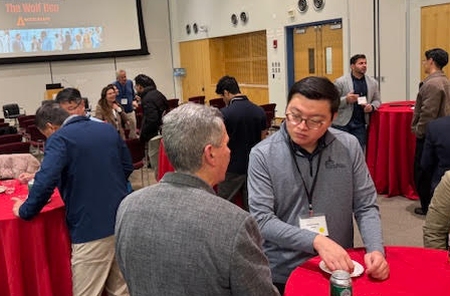
Wolfs of Main Street: Eager to share their innovation stories, dozens of startup founders packed into the first Wolf Den event.
“There’s only so much you can do on Zoom, only so much you can do by yourself … you’ve got to get out and move around and really seize the moment now.”
Stony Brook University is a “great partner” on this quest, according to Lloyd, who extolled the virtues of a “regionally recognized” affiliate with “lots of technology, lots of resources, lots of sharp minds.”
And Accelerate Long Island is a perfect component for SBU’s commercialization engine, noted Hannah Estes, the university’s director of student innovation and entrepreneurship.
“One of my favorite things is taking a startup and connecting it to higher education,” Estes noted. “I think they do a really good job with that.”
And that was the entire point of the inaugural Wolf Den, which was the “first of many,” according to Acquaviva, and therefore as much a “beta test” as an “ecosystem-building event,” according to Estes.
“We want to get some feedback from this event, see what’s working and what can be better,” she said. “This will be one of several events focused on innovation and entrepreneurism.
“Industry needs to be open to partnering with academia,” Estes added. “Especially in these current times, we need to have other ways that we can self-sustain.”