By GREGORY ZELLER //
Some of the New York Institute of Technology’s brightest minds and boldest scientific thinkers are soaring through a new agreement with NASA.
 The National Aeronautics and Space Administration has contracted New York Tech’s College of Engineering and Computing Sciences to build “unique technology” prototypes based on NASA patents, and to create “professional marketing materials” NASA can use to commercialize the new technologies.
According to the agreement, the work will be done by students and employees in the college’s Entrepreneurship and Technology Innovation Center, New York Tech’s innovative applied-sciences hub.
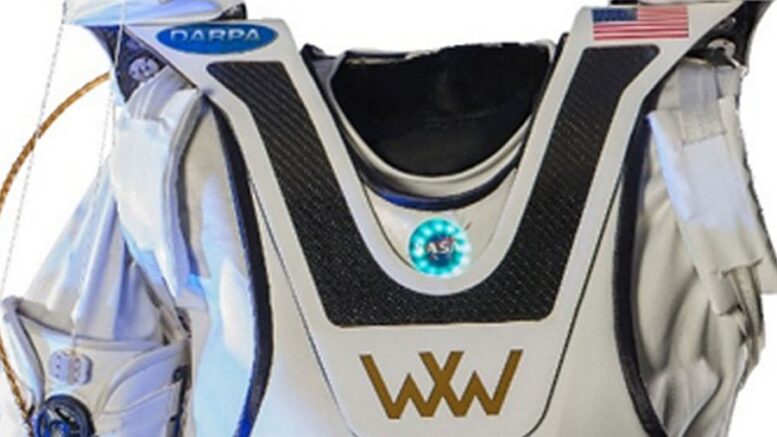
Seven New York Tech student-employees – pursuing degrees in computer science, mechanical engineering and electrical engineering – are jumping right in. On their drawing boards first is a prototype for a robotic therapy vest, designed by NASA to support patients with neurological impairments.
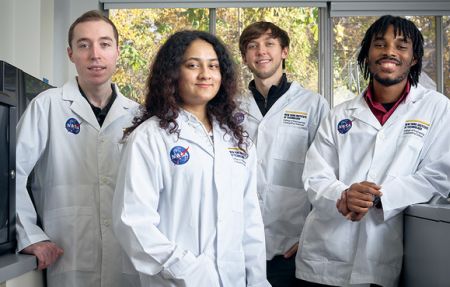
Coat drive: New York Tech students (from left) Robert Doxey, Hibah Agha, Robert Maksimowicz and Lincoln Dover are lending their big brains to NASA.
A functioning model of a high-tech device known as a “c-gauge” – which measures cord tension in parachutes, nautical sails and weather balloons – will also be built by a multidisciplinary team of ETIC students.
The initial NASA contract runs only through August 2022 and covers just the seven students. But “the sky is the limit, in terms of potential opportunities for New York Tech students through this relationship,” according to ETIC Director Michael Nizich.
“It’s possible that over time, several dozen (students) from across the university could be working toward building or supporting NASA products,” Nizich added, “in addition to pursuing internships and perhaps a full-time position at NASA after graduation.”
While the alliance provides obvious benefits for New York Tech and participating students, it’s also a winner for NASA, according to Kris Romig, who heads up commercialization services at Houston’s Johnson Space Center.
 “The purpose of this agreement is to provide an operational structure and framework for NASA to move various unrealized and undeveloped intellectual property further toward commercialization through prototyping and production services,” Romig said in a statement.
The space agency actually approached New York Tech about working with the ETIC, which impressed NASA principles with a new-technology prototyping job – arranged by Albany’s Empire State Development Corp. – for Wyandanch-based startup Grub Guard.
After viewing the Grub Guard work, NASA’s Technology Transfer Office reached out to ETIC with plenty of good questions, according to Nizich.
“We worked to explain the ETIC’s programs and services and the College of Engineering and Computing Sciences’ labs and facilities, student capabilities and engagement,” said the ETIC director, also an adjunct associate computer science professor.
“NASA ultimately requested a proposal for us to take various unrealized NASA patents … (and) create early-phase prototypes of those technologies for NASA to demonstrate to their industry partners,” Nizich added.
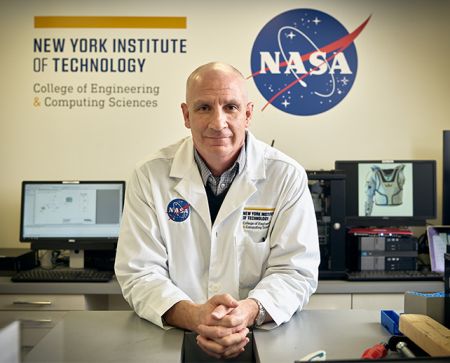
Michael Nizich: Infinity and beyond.
College of Engineering and Computer Sciences Dean Babak Beheshti labeled the first NASA agreement “very exciting,” stressing that “it is not a grant” and noting that it could open doors to a wide range of possibilities for the college and the ETIC.
“Importantly, this work is guided by a performance-based contract,” Beheshti said this week. “It serves as a pilot for New York Tech to demonstrate our rich and talented resources in terms of our labs, facilities, students and their faculty advisors.
“It is entirely possible that, as we are building the prototypes to specification, we’ll create some new technology or component in the process,” the dean added. “This kind of unique New York Tech innovation could end up benefitting businesses in the region and providing additional capability to outside companies.”