By GREGORY ZELLER //
Mental and physical health challenges, the marijuana black market, education, the climate and New York’s ongoing affordable-housing crisis – not to mention budget-balancing – are all on Gov. Kathy Hochul’s mind, and part of her 2024 agenda.
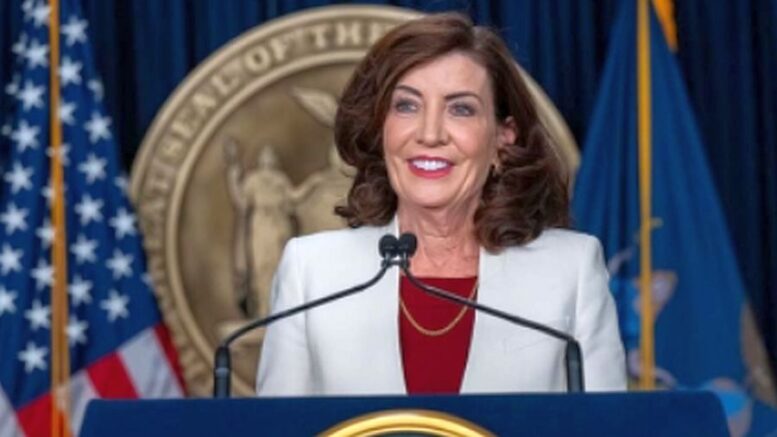
 Delivering her annual State of the State Address Tuesday afternoon, the governor trumpeted past successes, economic and otherwise, and laid out an elaborate plan for the coming year – though not as ambitious as her expensive 2023 agenda, which itself marked a noticeable dial-down from the then-rookie-governor’s shoot-for-the-moon 2022 plan.
This was a more pragmatic Hochul, acknowledging gaps between the state’s mental-health services and criminal-justice record (“New Yorkers will not be able to let their guard down until we fix our mental-health system,” she noted) and introducing yet another plan to address New York’s deepening housing crisis.
The new housing plan was, essentially, an admission that her past affordable-housing efforts fell short, including her bombastic vow one year ago to build 800,000 new statewide housing units, partly by requiring municipalities to meet specific housing quotas – a plan that met swift, significant and successful resistance.
On Tuesday, a far less pollyannish Hochul introduced 204 proposals in all, including several pitches revealed in a series of press announcements over the last week, such as the first expansion of New York’s consumer-protection laws in more than four decades; a multimillion-dollar “NY SWIMS” initiative designed to increase the number of state-owned public pools; a strategy to improve reading proficiency in state-run schools (including a SUNY and CUNY Microcredential Program ensuring educators utilize evidence-based best practices); and a six-point plan to combat infant mortality.

Weed worry: New York State is losing millions of tax dollars to the marijuana black market.
She implored listeners to “just imagine the possibilities” as she introduced a funding plan for a multifaceted AI research and implementation program, while adding a plethora of previously unmentioned policy pitches: cracking down on illegal marijuana sales, combating hate crimes, bolstering New York’s agricultural industries (including new financial support for state dairy farmers and fresh “youth agricultural leadership” opportunities) and a general doubling-down on already-nation-leading clean-energy policies, all detailed in a 181-page playbook titled “State of the State 2024: Our New York, Our Future.”
“The State of New York is stronger, healthier, safer and more affordable than it was two years ago when I became governor,” Hochul told the New York State Assembly, the State Senate and others in attendance. “But there is more work to do.
“Every proposal announced today serves to improve our state and ensure our communities are not just surviving, but that they are thriving,” the governor added. “Our New York is our future, and the future is brighter than ever.”
The governor’s playbook says little about how Albany will pay for all that brightness – though it does promise, on Page 2, that “additional policies and funding details will be included in the upcoming Governor’s Executive Budget.”

Pool party: The state will build more public pools, if the governor has her way.
Critics have thoroughly lamented what’s projected to be a $4.3 billion state budget deficit this year. On Tuesday, the governor largely steered clear of financial particulars, though she assured the audience that Albany “won’t spend money we don’t have.”
It has some money, obviously, because even Hochul’s slightly-less-ambitious agenda won’t come cheap. Other plans floated by New York’s chief executive include a multiyear mental-health expansion plan that will create 200 new inpatient beds across the state and new admissions standards for SUNY and CUNY schools (including automatic admission to State University of New York and City University of New York schools for students in the top 10 percent of their graduating high school classes).
Hochul’s new multipronged housing strategy, meanwhile, would offer financial incentives for new NYC housing projects and create a $500 million capital fund for the development of some 15,000 housing units on state-owned land, among other ideas.
One hot topic the State of the State avoided completely was immigration. Hochul said separately she would address the state’s role in the national migrant crisis with a separate series of proposals slated to be revealed next week.