By GREGORY ZELLER //
After remaining virtually hidden since the late Triassic period, a new dinosaur species has joined the prehistoric parade, thanks in part to the efforts of a Stony Brook University scientist.
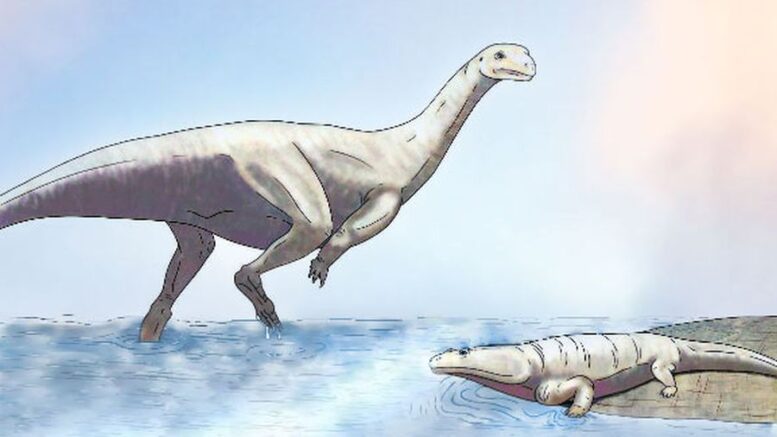
 Meet Musankwa sanyatiensis, a long-necked, bipedal herbivore dating back about 210 million years (the earliest epoch for dinosaurs, according to science’s best guesses). The previously unidentified sauropodomorph – a dinosaur suborder including the largest animals to ever walk the Earth – has been identified in Zimbabwe by an international team of paleontologists including Kimberley Chapelle, an assistant professor in the Department of Anatomical Sciences at Stony Brook University’s Renaissance School of Medicine.
A swamp-dweller weighing in at an impressive 850 pounds, Musankwa sanyatiensis was one of the larger dinosaurs of its era. Specifically, it is a member of Massopoda, a sauropodomorph clade that lived between the Late Triassic and Late Cretaceous periods.

Kimberley Chapelle: Welcome to Triassic Park.
It was identified based on the fossilized remains of a single hind leg – including its thigh, shin and ankle bones – that was originally unearthed in 2018, with scientists taking more than five years to confirm it was, indeed, a previously undiscovered species.
The work is described in a scientific paper published in the latest issue of Acta Palaeontologica Polonica, a quarterly, peer-reviewed, open-access international scientific journal of paleontology and paleobiology.
The article – authored primarily by Professor Paul Barrett of the Natural History Museum of London and co-authored by six associates, including Chapelle – labels Musankwa sanyatiensis as the fourth dinosaur species ever identified in Zimbabwe and the first discovered in the landlocked central Africa nation in more than 50 years.
Its name comes from the Musankwa, a houseboat that served as the research team’s home and mobile laboratory during 2017 and 2018 field expeditions to Lake Kariba, the world’s largest artificial reservoir straddling the border between Zimbabwe and Zambia. “Musankwa” means “boy close to marriage” in the Tongan language.
While closely related to late-Triassic contemporaries in South Africa and Argentina, the new dinosaur species stands alone, according to Chapelle, who helped excavate the fossilized specimen.
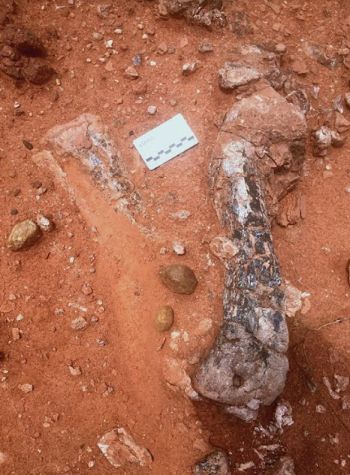
Dem bones: The fossilized remains don’t look like much, but they’re enough to identify Musankwa sanyatiensis as a previously unknown species.
“Despite the limited fossil material, these bones possess unique features that distinguish them from those of other dinosaurs living at the same time,” the vertebrate paleobiologist noted.
Chapelle also contributed to the digital reconstruction of the newly discovered dinosaur based on a micro-CT scan (a 3D-imaging technique leveraging X-ray technology) of the unearthed bones and helped determine Musankwa sanyatiensis’ position on the dinosaur family tree through phylogenetic analysis, a comprehensive study of how specifies evolve through genetic changes.
According to the SBU researcher, those advanced 21st Century sciences suggest there are more discoveries still waiting to be made from the earliest age of dinosaurs.
“Based on where it sits on the dinosaur family tree, Musanwka sanyantiensis is the first dinosaur of its kind from Zimbabwe,” Chapelle added. “It therefore highlights the potential of the region for further paleontological discoveries.”