
By TERRY LYNAM //
Celebrating, grieving, alleviating stress, watching a ballgame, traveling, relaxing at home – there’s always a good reason to take a drink.
 Alcohol is imbedded in our culture. The numbers have fluctuated over the decades, but Gallup polling over the past 85 years has been pretty consistent: More than six in 10 Americans drink alcohol.
For public health officials, the question has always been: How much is too much?
For nearly three decades, U.S. dietary guidelines have recommended that men limit themselves to two drinks a day and women to one (one standard drink is defined as a 12-ounce beer, five ounces of wine or 1.5 ounces of 80-proof distilled liquor).
But as the federal government prepares to update alcohol guidelines next year – for the first time since 2020 – there’s growing pressure to tighten them based on the rising number of alcohol-related deaths across the nation.
Uncertainties about what Americans will be told about the health risks of alcohol is generating much handwringing among government agencies, scientists the alcohol industry and its Congressional allies. The research methods public-health experts are using to develop the new recommendations, the processes for enacting them – it’s all being questioned.

Terry Lynam: Counting cocktails.
The industry, which spends millions of dollars every year lobbying lawmakers at all levels of government, is unsettled by the prospect of tighter consumption guidelines fueled by health concerns. Fewer sales – particularly among consumers ages 18 to 34, who are already drinking less than previous generations (many opt for cannabis instead) – is the big concern.
The World Health Organization raised alarms last year, saying no amount of alcohol is safe because it’s a carcinogen and consumption increases the risk of cancer (alcohol is actually among the three leading preventable causes of cancer, alongside tobacco use and obesity).
Also in 2023, the Canadian Center on Substance Use and Addiction significantly tightened its alcohol-consumption guidelines, recommending that people drink no more than two drinks a week to lower health risks (it previously said 15 drinks a week for men and 10 drinks a week for women presented a low health risk).
The U.S. Centers for Disease Control & Prevention says alcohol-related deaths have increased among all age groups since the start of the COVID pandemic, estimating that excessive drinking kills about 178,000 people every year. About two-thirds of alcohol-related deaths were from chronic conditions that developed over time, including several types of cancer, heart and liver diseases, and alcohol-use disorder. The remaining one-third of deaths were from binge drinking that resulted in motor vehicle crashes, alcohol-involved drug overdoses, alcohol poisonings and suicides.
Meanwhile, previous research maintaining that moderate drinking is beneficial to overall health has been challenged by more recent studies.
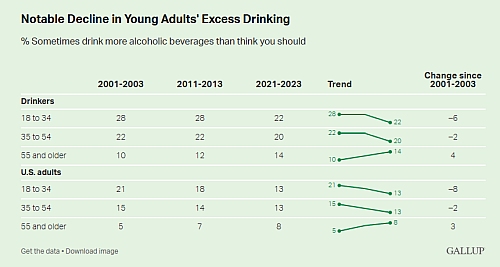
High and dry: Excess alcohol consumptions is already declining among younger Americans, who prefer pot. (Source: Gallup)
Looking for more definitive answers, the National Institutes of Health, the nation’s top medical-research agency, planned in 2018 to pursue a $100 million international study about the effects of moderate drinking on heart health – but had to abandon the study after learning that representatives of the National Institute on Alcohol Abuse and Alcoholism had lobbied beer and liquor companies to fund the trial.
Besides that obvious conflict of interest, an NIH internal investigation revealed that the study’s principal investigator, Kenneth Mukamal of Harvard’s Beth Israel Deaconess Medical Center, was in frequent contact with beer and liquor executives while designing the study, a claim he denied.
In a move that generated backlash from the scientific community, Mukamal and another Harvard researcher – Eric Rimm, who has also expressed the view that moderate drinking protects against heart disease – were nominated late last year to the federal committee that’s reviewing scientific evidence on the relationship between alcohol consumption and health outcomes.
But the National Academies of Sciences, Engineering and Medicine quickly backtracked on their appointments after an outcry from critics. As one public-health researcher quipped, “It’s like putting the fox in charge of the henhouse.”

Cruz cringe: When Ted Cruz speaks, there’s definitely some ass in there somewhere.
Despite those objections, another Harvard researcher with alcohol-industry financial ties was later appointed by the National Academies to the dietary panel developing alcohol consumption guidelines – Luc Djousse, who like his Harvard colleagues has studied the effects of moderate alcohol consumption on heart disease.
The makeup of the committee (many are experts in biostatistics and data analysis, with past research that does not focus primarily on alcohol and health) and how it’s going to proceed in developing drinking guidelines continue to be sources of contention among alcohol-industry leaders and scientists advocating for more-stringent recommendations.
The big question, of course, is whether the government’s advice – including possible warning labels about the link between alcohol and cancer – will have any impact on America’s drinking culture.
The response from right-wing libertarians is unequivocal. As U.S. Sen. Ted Cruz (R-Texas) said in a recent interview, “If they want us to drink two beers a week, frankly they can kiss my ass.”
Terry Lynam is a communications consultant and former senior vice president/chief public relations officer for Northwell Health.