By GREGORY ZELLER //
A new federal law governing Chinese imports bodes very well for a leading Long Island innovator.
 Stony Brook-based Applied DNA Sciences – a DNA-based supply-chain authenticator that’s grown into a leading supplier of unique DNA strands for global researchers and a trusted manufacturer of polymerase chain reaction-focused technologies – is ringing bells as the Uyghur Forced Labor Prevention Act kicks in.
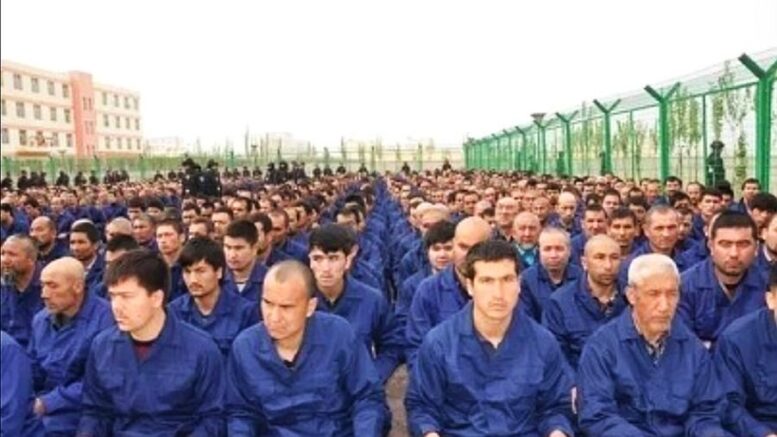
Signed into law by President Joe Biden in December, the UFLPA summarizes a U.S. Congressional investigation that determined the government of the People’s Republic of China has “arbitrarily detained” as many as 1.8 million people in the Xinjiang Uyghur Autonomous Region of China since 2017, locking them in “extrajudicial mass internment camps,” formal prisons and other detention centers.
There, the prisoners are subjected to forced labor, torture, political indoctrination and “other severe human rights abuses,” according to Congress, which crafted the UFLPA primarily to keep all goods made with forced labor in the Xinjiang Uyghur Autonomous Region out of the United States.

James Hayward: Border line.
With U.S. Customs and Border Protection and the U.S. Department of Homeland Security keeping watch, the new law – which took effect Tuesday – comes complete with a DHS-approved “implementation strategy,” detailing the techniques and tools U.S. officials can use to determine the origin of manufactured imports, or the materials and components used in manufactured imports.
Among the cutting-edge evidential resources in play are DNA traceability and isotopic testing. Enter Applied DNA, where such cutting-edge sciences are par for the course.
Both are central components of the biotech’s CertainT authenticity platform – a “100 percent American” solution, notes Applied DNA President and CEO James Hayward, that applies customizable, DNA-based tracing technology to this important human-rights issue.
Not only is CertainT the ideal solution, it may be the only solution: While the new law is an appropriate response to the dire situation in the Xinjiang Uyghur Autonomous Region, enforcing it might be difficult, according to Hayward, who said “the high bar established by the UFLPA, with its documentary and supply-chain management requirements, places a burden on importers that cannot be adequately met by fungible reporting frameworks, such as conventional paper or electronic systems.”
But “CertainT is … unique in its ability to offer multiple traceability solutions,” Hayward added, “including DNA traceability and isotopic testing that are both cited in the (implementation) strategy.”
With Applied DNA positioned for a major role in the application of the new law – and the Biden administration funneling $70 million to the cause, covering hundreds of new CBP inspectors – the company senses a “precursor to potentially broader industry application,” the CEO noted.
“As a [domestic] company, we applaud the imperative … moving federal law toward action,” Hayward said Tuesday. “Not only for its potential to be transformative to our supply-chain security business, but also to deliver clear societal and ethical benefits to the American consumer.”