By GREGORY ZELLER //
A Long Island-based leader in energy-industry robotics has partnered with one of the world’s largest energy-delivery systems to reinforce modern electricity grids – and safeguard line workers along the way.
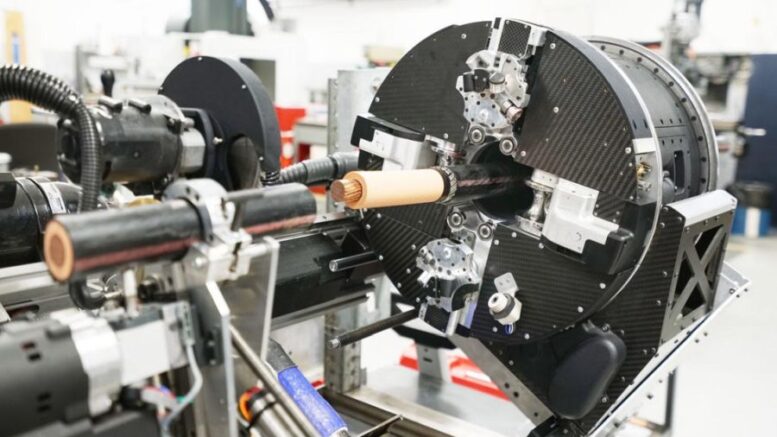
 Hauppauge-based ULC Technologies and Con Edison Company of New York have developed and field-tested a next-generation Cable Splicing Machine designed to automate the termination of medium-voltage power cables – a big step toward improving the reliability and resilience of power-grid connections and a giant leap toward improved safety for utility workers, who can enjoy less direct exposure to high voltages.
In a nutshell, the machine automates cable-end preparation – a complex operation usually performed on medium-voltage feeder cables in underground vaults – with the use of multiple independent subsystems, all controlled through a centralized processing computer and user interface.
By centralizing the process, the Cable Splicing Machine can shorten the overall feeder-outage duration, reduce grid stress and improve network resiliency, according to ULC Technologies.

Ali Asmari: Precision control.
More importantly, it can improve worker safety by taking them out of those underground vaults – especially important since distribution-feeder outages tend to occur during storms, severe heat waves and other adverse weather conditions, when the going is double-tough.
Instead of sending workers into those underground vaults to repair outages, the Cable Splicing Machine “can be secured onto the middle of an uncut cable in the field,” noted ULC Technologies Director of Infrastructure Operations Ali Asmari – a much safer environment to conduct necessary repairs.
“[It] uses electrical actuators to provide precise coordinated motion along the axial and circumferential directions,” Asmari said. “The machine’s tool plate consists of numerous tools capable of stripping back each layer of the cable to a desired dimension using precision tool-depth controls.”
As complex as that sounds, it’s actually a quantum leap toward simplification – a combination of live camera feeds and auxiliary subsystems that can short out and cut cables as necessary, with operators high and dry and far from danger.
That was a major selling point for project partner Con Ed, where “worker safety is paramount,” according to Con Edison Electric Operations Senior Vice President Patrick McHugh.
 “The technology used in this tool will enable our workers to splice high-voltage cables efficiently, uniformly and, most importantly, more safely,” McHugh added.
The New York City-based utility and ULC Technologies – which launched in 2001 as ULC Robotics but rebranded after being acquired in 2020 by North Carolina-based engineering firm SPX Corp. – began field trials of the Cable Splicing Machine earlier this year. They plan to demonstrate it at Distributech International, a leading annual power transmission and distribution event scheduled for later this month in Florida, with field deployments to follow.
Working with big-time partners is nothing new for ULC Technologies, which has previously teamed with PSEG-LI to deploy power-line inspecting aerial drones and tag-teamed a state-of-the-art gas-main inspection robot in conjunction with SGN Natural Gas, among the United Kingdom’s leading utilities.
Con Ed fit right into that pantheon of major-league partners – and the utility, one of the nation’s largest investor-owned energy companies, was excited to team up with the longtime robotics ace, according to McHugh.
“When you reduce the risk of performing thousands of splices each year, improve their accuracy and efficiency, it benefits workers, grid reliability, cost effectiveness and value,” the senior VP said. “That’s a win, win, win for Con Edison, its workers, (its) customers and the industry.”