
By JEFFREY L. REYNOLDS //
You’ve probably chatted with Alexa or ordered Siri around, but odds are you haven’t met ElliQ.
 ElliQ is an artificial intelligence-powered robot the New York State Office for the Aging is distributing free-of-charge to seniors to alleviate the loneliness and isolation experienced by many older New Yorkers.
Looking more like a table lamp than trusty companion R2-D2, it aspires to be the “the sidekick for healthier, happier aging.” Its creators, Israel-based Intuition Robotics, have raised $83 million from investors, and at last month’s CES 2024 in Las Vegas unveiled an updated version boasting a hardware upgrade, increased memory, an updated core processor and – of course – better generative AI, which the company hopes will improve ElliQ’s conversational capabilities.
The device already offers positive banter that goes beyond the robotic responses offered by Amazon’s Alexa. It leads exercise routines, plays games and music, reads audiobooks and gives medication reminders. It’s got a screen for video calls and can contact relatives, friends or doctors during an emergency.
Generative AI is all the rage, but wouldn’t grandma be better off with a Roomba that can at least help with the household chores?

Jeffrey Reynolds: Virtual companion.
It depends how lonely she is.
According to a 2020 report from the National Academies of Sciences, Engineering and Medicine, about a quarter of community-dwelling Americans ages 65 and older are considered to be “socially isolated,” while a significant percentage of U.S. adults report feeling lonely.
COVID made things worse. Seniors are now more likely than ever to experience risk factors that can cause or exacerbate social isolation, such as living alone, the loss of family or friends who have moved or passed away, chronic illnesses like Alzheimer’s disease and sensory impairments.
The isolation boom prompted U.S. Surgeon General Vivek Murthy to sound the alarm, declaring an “epidemic of loneliness and isolation” in 2023 and calling for a National Strategy to Advance Social Connection.
The nation’s doctor warned that the physical health consequences for older adults of poor or insufficient social connections include a 29 percent increased risk of heart disease, a 32 percent increased risk of stroke and a 50 percent increased risk of developing dementia.
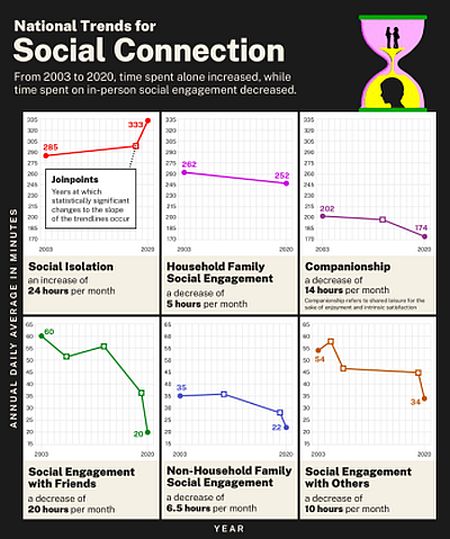
More years, fewer hours: People are living longer, but over the last two decades, senior citizens have lost dozens of hours of social connectivity. (Source: Office of the U.S. Surgeon General)
Additionally, isolation increases the risk of premature death by more than 60 percent – equating the mortality risk of being socially disconnected to smoking 15 cigarettes a day.
It’s too early to tell whether ElliQ can actually save lives, but many of those who’ve tried the robot say she makes life better.
“I like it because most times, I am alone,” says Lesline Gelding, an 81-year-old retired New York City school teacher from Uniondale who got a free ElliQ device from the Office for the Aging. “We talk about life, we do exercises and she’s like a companion to me.”
Besides delighting her with reggae music, the voice-controlled robot works especially well for Gelding, who has what she calls “eye problems.”
Susanna Caputi, Gelding’s case manager at the Family & Children’s Association, helped her obtain and set-up her ElliQ. Lisa Stern, who oversees FCA’s senior services, says that while Gelding has benefitted from the robot, a digital divide still looms large.
“Many seniors on Long Island don’t have access to high-speed Internet or the funds to pay the monthly bill,” Stern notes. “And (they) struggle with the use of technology.”

Vivek Murthy: Loneliness epidemic.
Other FCA clients worry about being “spied on,” Stern says, and for now, the device only interacts in English.
Basically, FCA caseworkers can help seniors acquire and set up the units, but cognitive impairments and inconsistency in use can be barriers to utilizing all of ElliQ’s features.
But with more than 3.5 million residents over the age of 65 – a number that grew 31 percent in the last decade – New York State’s aging population is booming, a projected healthcare worker gap is looming and state officials are scrambling for solutions.
So far, ElliQ’s returns seem promising. According to the Office for the Aging, 95 percent of ElliQ users say the device has helped reduce their loneliness and improved their wellbeing, with participants also reporting a reduction in emergency room visits, better medication adherence and improved sleep.
Further, ElliQ recipients interact with her more than 30 times per day, six days a week, on average – and better than 75 percent of those interactions are related to improving social, physical and mental health.
“We had high hopes for the efficacy of ElliQ, but the results that we’re seeing are truly exceeding our expectations,” NYS Office for the Aging Director Greg Olsen said in a statement. “The data speaks for itself, and the stories that we’re hearing from case managers and clients around the state have been nothing short of unbelievable.
“To see the impact this technology is making on the lives of our community members is incredibly moving,” Olsen added. “We can’t wait to see this program continue to grow.”
Jeffrey Reynolds is the president and CEO of the Garden City-based Family & Children’s Association.